38 Comments
Do you consider comics credible reading?
Do you see comics as only for reluctant readers?
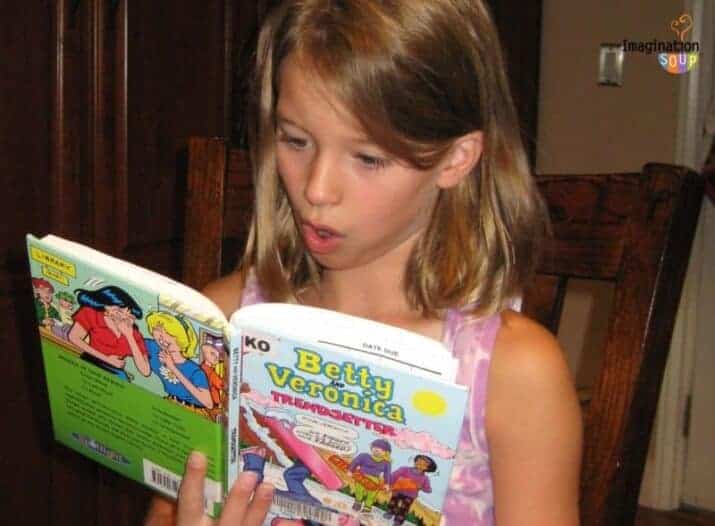
I strongly believe that comics and graphic novels count as credible reading materials and aren’t just for reluctant readers.
It started with my middle-school language-arts teacher mom who owned hundreds of comic books for her classroom; comics like Archie, Spiderman, Tintin, and classics. My mom believed that reading is reading. She went to the ends of the earth to provide her students with every possible option in reading material, comic books included. Which, of course, worked to get her students reading.
The truth is children need both variety and choice to become readers.
Comics can be the variety children need and not just for reluctant readers. Of course, if comics get a reluctant reader reading, like in this story about Rose written by her mom, author Victoria Hanley, great!
Wait . . .
What Is a Comic, a Graphic Novel, and a Manga?
So let’s define terms — comic, graphic novel, and manga — before we continue.
“Comics, like music, are a medium. The graphic novel is a format used to deliver the medium, like a cd is a format for delivering music. A graphic novel is just a longer format comic book,” explains John Shableski aka The Graphic Novels Guy, and my go-to source for everything comic.
Shableski patiently explains to me (over and over) that graphic novels are NOT a genre. Even if you read it on well-known sites like these – here, here, and here.
He elaborates, “The term graphic novel is really a misnomer. Graphic implies art and the word novel adds even more confusion. People are often confused by the use of the word graphic because they think it implies pornography. Now we can use terms like graphic nonfiction, graphic fiction, graphic mysteries etc. to describe the many genres within the comics story telling world.”
“Manga is the Japanese term for describing the comics medium. For adults, it is a challenge as it reads backwards, or right to left. Kids of any reading level have an amazing ability to adapt to the format. Part of it is due to the fascination with the stories, and the other is because most adults can’t read it,” explains Shableski.
But why should you care?
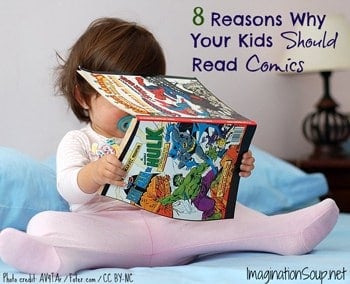
8 Reasons to Let Your Kids Read Comics
1. Comics are fun to read. Why does reading have to be miserable? It doesn’t. Which is why I love to read YA because it’s fun. I love reading literature (my major in undergrad) but it’s not always fun.
2. Comics contain the same story elements and literary devices as narrative stories – characters, conflict, resolution, setting, symbolism, theme, point of view, and so forth.
3. Comics provide built-in context clues. Because comics are visual, even if the text is difficult, the visuals give the reader support in comprehending the story.
4. Reading a comic is a different process of reading using a lot of inference. With a comic, readers must rely on the dialogue and the illustrations. The reader must infer what is not written out by a narrator, a complex reading strategy.
5. Readers need variety in their reading diet.
6. We’re a visual culture and the visual sequence makes sense to kids. (See Marc Prensky’s research on Digital Natives.)
7. Reading comics may lead to drawing and writing comics. Linking reading and writing is important. Comic book creation is particularly enticing for kids who prefer drawing to writing normally but will make exceptions for dialogue bubbles.
8. The selection of graphic novels is bigger, better, and reaches a wider age-range than before. Every month more comic books and graphic novels enter the market for younger readers and provide more good choices from which to pick.
Parents, a word of warning: Preview the comics to be sure the content is appropriate for your child. Some comics, even in the children’s section, are violent, use bad words, or portray women in stereotypical, unflattering ways. If you’re going shopping for comics, most comic book stores in the Denver area do not carry comics for kids but comics meant for adults; the content and language say my friends at Enchanted Grounds aren’t generally appropriate for children. Call around before you go shopping.
Parent and Teacher Resources
Why comics are good for kids from Parent Map.
Build reading skills with comics.
Scholastic’s publication on using graphic novels with children and teens.
Reading with Pictures is a non-profit that advocates the use of comics in the classroom and The Graphic Classroom gives teachers educational graphic novel and comic book suggestions.
This article at the Graphic Novel Reporter gives advice for using comics with your children.
Hear from a librarian why she uses graphic novels and read this article by Jesse Karp in the ALA magazine on using sequential art to teach.
High school English teachers have a ning about using graphic novels in the classroom.
Interview with author, Kate Monnin, about teaching with graphic novels.
Comic Book Classroom website.
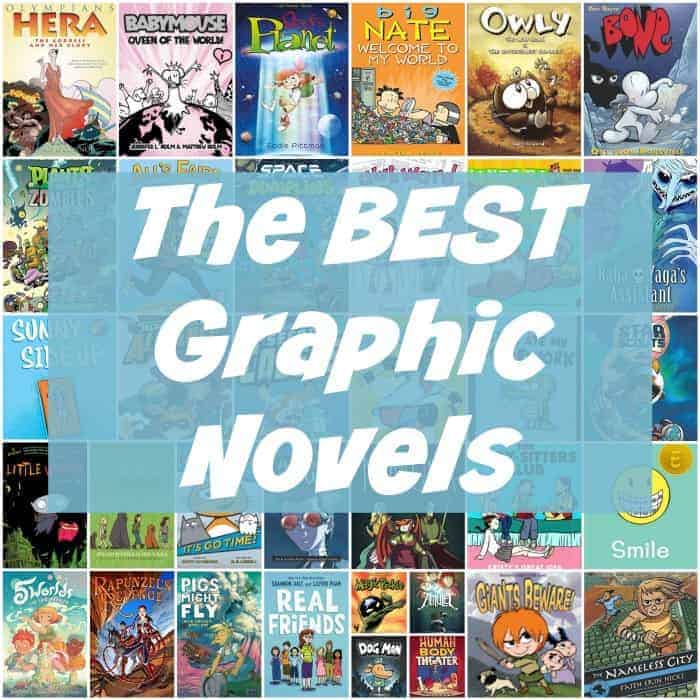
Tomorrow: graphic novel recommendations for kids
Thursday: teachers and add more to the discussion about comics
Subscribe to Imagination Soup by email and get a FREE eBook with Pretend Play ideas.


Melissa Taylor is a mom and educator from Denver who is passionate about playful learning. Thanks for visiting the site!


38 Comments
Wonderful post that further illustrates the advantages of incorporating comic books to improve literacy for kids. I was especially intrigued by the reading via inference. Great point.
Please add to your list as a resource my overview of Comic Book Literacy, a documentary film by Todd Kent.
http://cutemonster.com/2010/11/comic-book-documentary-film/
Thanks.
Vincent | CuteMonster.com
Thanks, Vincent — I will send people your way in my Friday post!!
I agree! yeah! my children love comics, and for a while, i hesitated to let them read them…but then we found Garfield and Calvin and Hobbs! And, it snowballed from there. Now, we search for great vintage comics, and some new stuff too. Thanks for your post
Anyone have great lists of comics or graphic novels that portray girls and women more appropriately/ have great storylines, etc.? Thanks!
yes – coming up tomorrow. But to get you started for your kids’ ages try Rapunzel’s Revenge, The Secret Science Alliance, Amelia Rules, and the Popularity Papers.
Don’t forget the Babysitter’s Club books illustrated by Reina Telgemeyer, and her newest one Smile.
On a side, note, thank you! This is exactly what I’ve been trying to explain to people for ages! I review upcoming graphic novels for younger readers on my blog, and I would love to be able to link to this. This is fantastic, and even better, it looks like you’re a fellow Coloradoan!
Yes – in Centennial. What about you? Glad to meet another comic book fan and blogger! Going now to check out your site.
Good stuff!
I think reason #7 above is a big one. Both of my boys eased into writing through drawing comics and slowly incorporating dialogue bubbles and captions.
I know one homeschooling mom who began homeschooling because of the bad school situation one of her boys was in. One example: his teacher would not allow him to read Calvin and Hobbs for his “free reading” requirement–even at home! (My friend and her boys named their subsequent homeschool Calvin Academy.)
I also enjoyed this post called Comics Make You Smart on Here in the Bonny Glen: http://melissawiley.com/blog/2011/08/11/comics-make-you-smart/#comments
I LOVE this post and I couldn’t agree more. I just did a post on graphic novels and how it helped to motivate my not so eager reader to start to love reading. My oldest is reading V For Vendetta for his wrting class in college.
I was skeptical about a summer reading assignment my daughter had to complete for Honors English 9. She had to read the graphic novel version of Kafka’s “The Metamorphosis.” But I saw how it affected her and how she readily grasped the themes. Also, it really lends itself to the graphic novel format without losing the depth of the story.
I’m a convert and totally on board, as long as they are done well and used thoughtfully.
At this point, I’m willing to try ANYTHING to get my 7-year-old excited about reading. I tried Garfield this summer and it didn’t hold her interest (though she’s obsessed with cats) so I’m going to keep trying. I grew up with an extensive collection of Archie comics.
I have been an avid and voracious reader since I was about 6 or 7, and I have also always loved comic books. I have never worried when my kids wanted to read comics. It’s fun and enjoyable. Of course some aren’t age-appropriate, but the same holds true for more conventional novels as well.
Melissa – Great post. I agree, comics should be credible reading. They are reading and reading for fun is just as important if not more so as you become an adult. I remember loving the Garfield and Calvin and Hobbs cartoons in the paper as a kid. I would grab the Sunday paper each week and read thru them.
Thanks Melissa, I have ordered them all from the library!
I look forward to more tomorrow!
Love it! ANYTHING that gets kids excited about reading and writing is a great thing. Our comic book writing class is one of our most popular – it’s amazing to see how much plot some children can layer in a story while being so concise!
Love, love, love this post! My kids read anything and everything so I know I am lucky there. This summer they found some of my older son’s Calvin and Hobbes and they just love them! I also ordered Rapunzel’s Revenge and Calamity Jack. I grew up reading comics and so did my husband so this was fine with us (as long as they still read the other books). I have always looked at comics as a fun approach to reading and if they are reading, well, they are reading!
When I began homeschooling I found some graphic biographies or history from Graphic Library that are a wonderful way to educate your children and let them read comics. It’s a great bit of history and while it’s not my favorite graphics, my kids loved them and it was an extra bonus to work we were doing. There are also several available about famous women in history (Helen Keller, Anne Frank, Marie Curie, Amelia Earhart to name a few).
I look forward to more on this!
Bravo, I’ve been preaching this gospel since I entered the classroom in 1969! Thank you, Melissa!
[...] that you know why kids should read comics, you need a list of the best comic books and graphic novels for kids. I’m also including [...]
[...] reasons kids should read comics. And one reason why they shouldn’t– systematic exclusion of [...]
[...] 8 Reasons to Let Your Kids Read Comics [...]
[...] More Comic Book Resources [...]
[...] 8 Reasons to Let Your Kids Read Comics [...]
[...] 8 Reasons to Let Your Kids Read Comics [...]
[...] at Imagination Soup, they ran a good piece with a solid message: “8 Reasons to Let Your Kids Read Comics.“ Check it out, there’s a lot of worthwhile links attached to the [...]
Wonderful article! I feel on schedule now, as I have just published an illustrated book for kids. Meet Franklin Bean comes complete with a Superhero! Don’t miss out!
[...] 8 Reasons to Let Your Kids Read Comics [...]
[...] 8 Reasons to Let Your Kids Read Comics [...]
[...] 8 Reasons You Should Let Your Kids Read Comics [...]
[...] 6 Reasons to Let Your Kids Read Comics [...]
[...] Melissa Taylor @imaginationsoup of Imagination Soup: 8 Reasons to Let Your Kids Read Comics [...]
I’ve been looking for two years for comincs for my daughter. She’s been reading since she was 3 (is now 5). I can only find graphic novels that are violent or otherwise inappropriate in one way or another in the library or at the bookstore. Where are the old-fashioned comics? We have no comics in our newspaper anymore.
wandis recently posted..Teach Kids to Think About Their Thinking — Metacognition
[...] 8 Reasons to Let Your Kids Read Comics [...]
[...] 8 Reasons to Let Your Kids Read Comics [...]
[...] 8 Reasons Why You Should Let Your Child Read Comics [...]
[...] Try comic books or graphic novels. 8 reasons why. [...]
[...] 5. 8 Reasons to Let Your Kids Read Comics [...]
[...] here is a great article from Imagination Soup called 8 Reasons to Let Your Kids Read Comics Share this post Hide Sites $$('div.d11442').each( function(e) { [...]
Love it! ANYTHING that gets kids excited about reading and writing is a great thing. Our comic book writing class is one of our most popular – it’s amazing to see how much plot some children can layer in a story while being so concise!