
Our Daughter’s Anxiety Connected to Sensory Processing Disorder
This post may contain affiliate links.
A few years ago we wondered if AJ had sensory processing disorder, SPD, and if it related to her anxiety.
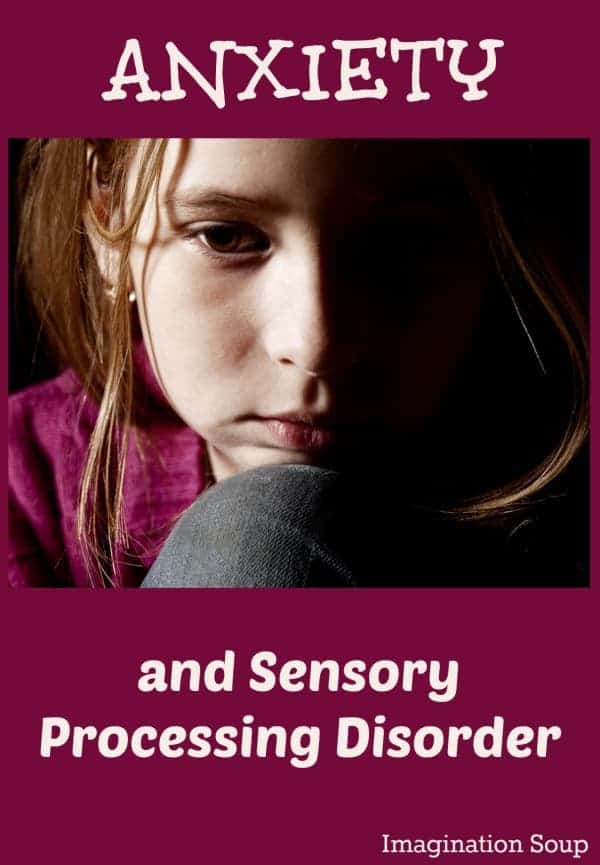
Sensory Processing Disorder
At the time, her anxiety was so overwhelming, she had trouble leaving the house. She’d curl up in the fetal position and cry. A lot. (It sucked.)
Anxiety, if you ever have experienced it, doesn’t make sense.
After a miserable mountain vacation trapped in our condo, I realized that she needed more help than I could give. Professional help.
So, we went to a therapist. Well, two cognitive therapists. (In retrospect, I would recommend finding a good art or play therapist. That’s another blog post though.)
After seven months or so of weekly therapy sessions and little improvement, the last therapist suggested we get AJ evaluated at Children’s Hospital for SPD.
Fast forward to a diagnosis — SPD with tactile over-responsiveness. In other words, her tactile sensory system was over stimulated all the time. It explained everything – like why she hated to be held as a baby, why she flinched when we hugged her, or why the lining of her socks had to be smooth and thread free. Maybe, it explained the anxiety. We would soon find out.
Occupational Therapy at Children’s
We started occupational therapy at Children’s. Sabrina, the wonderfully kind OT, gave us weekly homework including a brushing technique and joint compressions.
Brushing and compressions worked miracles – which is bizarre because they seemed a bit like voodoo. But the proof was the result . . . after only a few months, she was a different kid.
The biggest immediate result? The anxiety disappeared. (And with it, the curled-up in a fetal position melt-downs.)
Another reward of the therapy? Hugs and the occasional cuddle. Soon, AJ wanted me to lay down with her while she fell asleep. We had some catching up to do! I got to make up for so many years where she didn’t want to be touched.
Update
We didn’t do the therapy forever – at home or at Children’s. For one, it was just too expensive. We stopped when we saw results after about 9 months.
Now, when we see that AJ’s over stimulated or seems “off,” we’ll start brushing again for a few days. Sometimes we give her a full-body, super tight-squeeze bear hug. It immediately calms her down. (I know, it seems weird for a touch-sensitive person but totally works!)
AJ is growing into herself every day, without the interference of her over-stimulated senses. She’s an amazing child with a lot to offer the world. If it weren’t for us discovering SPD, we wouldn’t be where we are today.
 Which is why I’m telling you this. Only very recently are doctors considering SPD a legitimate diagnosis. But whether or not it’s in the DSM or people think it’s a “fad,” it’s a very real condition. And something you get help for.
Further Reading
Sensory Processing Disorder involves one or more of the senses and can be either over-responsive or under-responsive. The opposite of AJ is tactile under-responsive, also called a sensory seeker. These are kids who always are touching you, in your lap, petting others, hugging, seeking to be touched. I know of kids whose affected senses are hearing and vision.
SPD Foundation’s website
“Is it Sensory Processing or ADHD?”, ADDitude Magazine
SPD Blogger Network
I hope this helps you – or someone you know.
Do you have any questions for me? Experiences with this?
UPDATE: How Developing the Brain Helped with Sensory Processing, Anxiety & Food Pickiness For Our Kids
My first post about SPD . . .







I am a mother of three and have also elementary school taught for almost 15 years—-
I find it amazing that EVERYTHING—and I mean every single ‘different’ personality trait carries a label/diagnosis and ‘cure’.
I’m pretty sure I have OCD and ADD and anxiety and sensory processing disorder any number of spectrum disorders.
Gosh- what a world we live in—
Please don’t criticize those of us who are posting with children who have characteristics that are too the extreme and not the norm, which interferes with not only there education but the qualities of their lives. Shame on you, as a former educator. These problems are very real and at times very troubling and disturbing. Not to say very sad for those of us how have to watch our children cope with their severe anxieties or sensory problems. Try walking in our shoes for a day… a week…. or a month… then you can judge us.
I recently went to a speaker who taught us (teachers and OT’s about sensory processing. He also stated the same thing you did, some children are on the extreme. I had a student who had difficulties like your child, once I learned about the ways to help the child in school, behavior changed within weeks. We can’t teach a child that is curled up in the fetal position under our desk!
Thank you so much for this info on SPD – my daughter is now 22 but you have described her so perfectly. Another thing for her was colours – she said the colour purple made her feel sick. I am a preschool teacher & it is all making sense now as I reflect on children whom the experts wanted to label with autism & I fought with them as I knew it wasn’t right – thanks again!
I go back to work with a new insight into my 40 children!
wow! so she must have some vision over responsiveness?
you sound like a fantastic teacher!!
Thank you for sharing this post! I am familiar with SPD… it is not uncommon for children with Down syndrome to have it (my son has Down syndrome), often on a lighter scale. And brushing is what the families and therapists use, and the heavy vest/squeeze hug, and also the fabric-made swing that hangs from the ceiling, and sometimes a small tent in the classroom for the child to go to. Again, thank you for sharing this! I will be sure to post it/share it! (I get quite a few clients in my Montessori programs who have children with varying degrees of SPD.)
Thanks for sharing about your son. I didn’t know that. The small tent is a great idea — do you recommend any certain brand?
Vibration is great for giving kids some proprioceptive input. I bought two of those massage pads that vibrate and provide heat (we only use the vibration) for them to lay on sometimes. Had to get 2 so they wouldn’t fight over 1.
thanks!
My family has been on a 2 year journey as well, to figure out what was wrong with my son. He, too, has SPD, specifically under responsive vestibular system, vision processing problems, under responsive touch, and under responsive proprioception. He has done 8 months of vision therapy with a developmental optometrist (google COVD to find one near you) followed by 6 months of OT for SPD. We got the vision diagnosis first, then when everything wasn’t fixed completely by therapy, found out about SPD and OT.
If I had to start over, I’d probably do it a little differently, as I am still learning. First, I would find someone who can assess primitive reflexes. I have just read about the Masgutova Method, but have no experience with it. It seems that they are doing this type of thing at the Brain Balance places, but I do not live remotely close to one, so I have no experience with them either. This approach seems logical, though. There are many primitive reflexes which appear and then become integrated at certain points in life. The theory is that sometimes one or more reflexes do not integrate, and when that happens, other processes that use that neurological pathway are more difficult, as though there are speed bumps there. Therapy is then done that targets that reflex, and it becomes integrated. After reflexes are integrated, then move on to the other therapies.
I can not say enough about how vision therapy and occupational therapy changed my son’s life. Before, he was diagnosed ADHD, but was truly very close to Asperger’s with some of his sensory obsessions. Now, he is still ADHD, but it’s mild. In his GT class of 3rd grade kids at a public school, he seems very normal. Whenever he gets sick (had a recent sinus infection) he regresses a little and has poor coping skills. Outside of that, though, he is doing great.