• Home
  • Education
  • Preschool
  • Elementary
  • Reading
  • Writing
  • Math & Science
  • Books & Toys
  • Giveaways


Chimera vs. Stickman: The Difference Between Convergent and Divergent Thinking


Posted by Melissa Taylor on 09 Jan 2012
34 Comments

Tweet


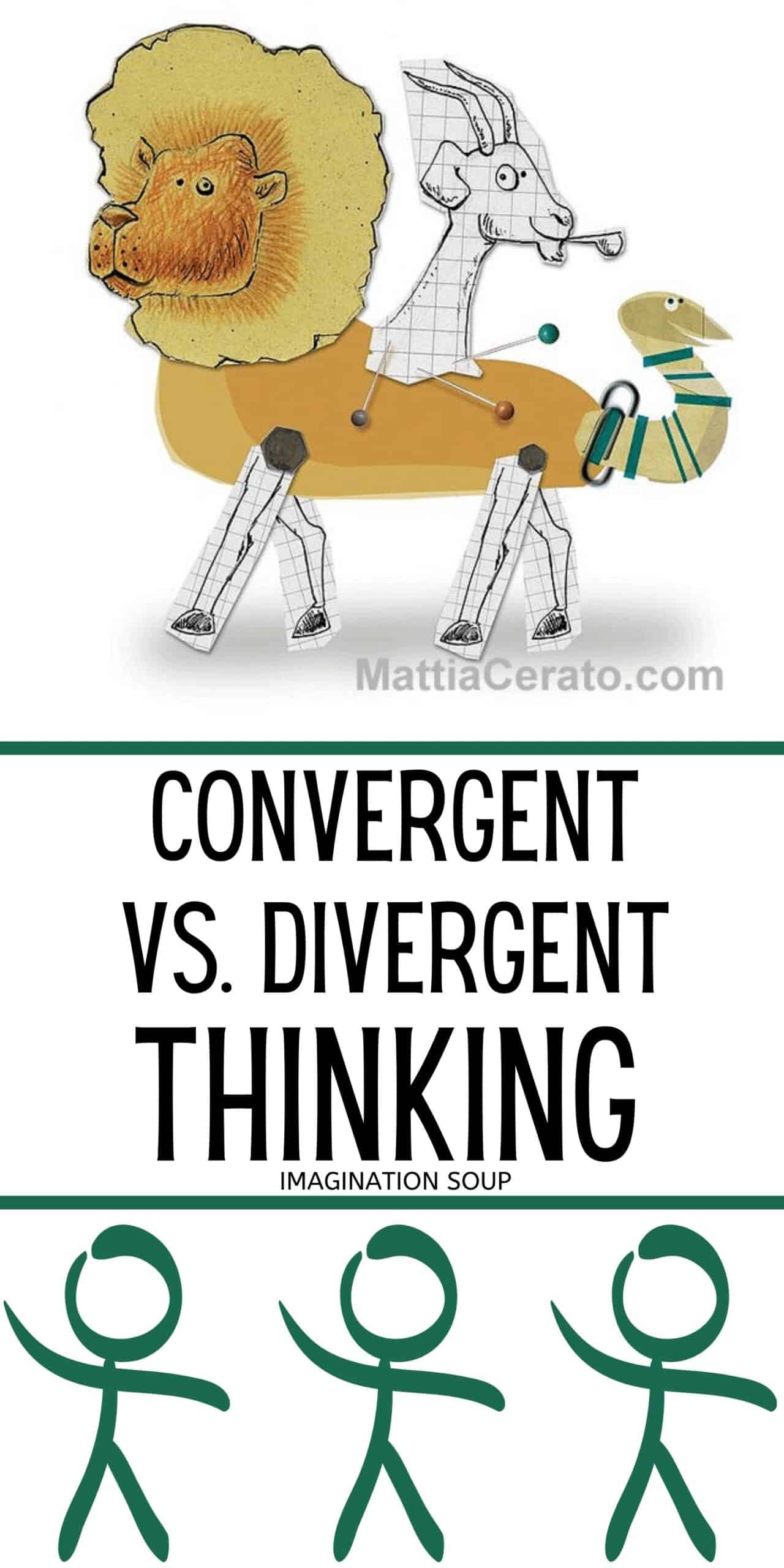
FreeEBook Chimera vs. Stickman: The Difference Between Convergent and Divergent ThinkingKids need to be creative. To understand how creativity works in the brain, we must first understand the difference between convergent and divergent thinking. Then, we must address the lack of divergent thinking in education.

The Stickman Education:

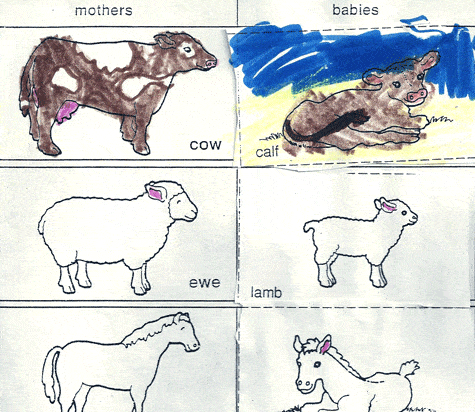
Linear, Convergent Thinking, Worksheet-Heavy, Early Academic Push, Skill & Drill, Right Answers

Can we resist the allure of “making your kid a genius” academic preschools and back-to-basics elementary schools who cut recess and the arts to focus on segregated subject areas. These schools prey on our deepest fears and goals for our kids telling us that if we don’t prioritize academics, our kids will be “behind.”

Except the basic assumption is incorrect. Pushing academics does not equal learning. Knowing facts does not translate into being able to problem solve. 

Think about it.

Children do not learn best in a “tell and show” method (aka. teacher tells them what to learn, kids show they learned it.) Sure, kids’ll learn something, but they won’t become thinkers, learners, creative problem solvers. Ritchhart, R., Church, M., Morrison, K. Making Thinking Visible (2011)

Linear thinking, or convergent thinking, is about learning facts, follow instructions, and solving problems with one right answer. Certainly it has it’s place. Math is an example of convergent thinking. Standardized tests are convergent as is the IQ test.

A friend’s 5-year old son, David, took the IQ test and did poorly. Look at his answers to see why, let’s just say he wasn’t a linear thinker.

  • What color is a banana? The “right” answer was yellow. David answered white and got the question wrong.

Another question he got wrong was this convergent question:

  • Do you know your address? David’s dad gave addresses, or speeches, all the time; but David didn’t so he said no. He got the question wrong. He actually did know his street address.

Children exposed to only linear thinking start ignoring the other possible answers and start believing that there is only one right answer. They become stickmen. One-answer automatons.

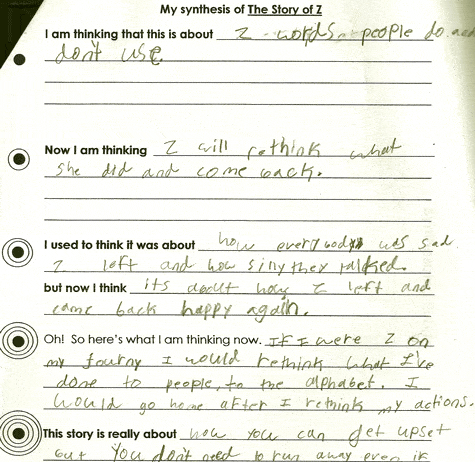
In Making Thinking Visible, the authors call this surface learning. They add, “When a worksheet is being filled out, the amount of interaction is reduced and the focus becomes doing the work rather than the learning.”

iStock 000003310509XSmall Chimera vs. Stickman: The Difference Between Convergent and Divergent Thinking

Watch out! A stickman can develop . . .

. . . learning disabilities (Healy, Jane. Different Learners, 2010)

. . . passivity towards learning

. . . into poor problem solvers (Michnik Golinkoff, R., Hirsh-Pasek, K., Eyer, D. Einstein Never Used Flashcards, 2004)

. . . inability to think (Kamii, 1984)

. . . behavior problems (Semrud-Clikeman, Margaret)

Remember that revealing study I mentioned yesterday about creativity from Land and Jarman from their book Breakpoint and Beyond which Sir Ken Robinson cited in this presentation? It showed how children at age five start their schooling as geniuses in creativity, problem solving, and divergent thinking (the opposite of convergent thinking) but lose this natural giftedness with each year in school. Each year they become more like stickmen.

I use the image of a stickman because your child will be as limited as a stick drawing with only convergent thinking.

The Chimera Education:

Constructivist Approach, Divergent Thinking, Collaboration, Projects, . . .

Divergent thinking is generating unique solutions and seeing various possibilities in response to questions and problems. (Watch Sir Ken Robinson’s speech on Changing Education Paradigms.)

Robinson education paradigms Chimera vs. Stickman: The Difference Between Convergent and Divergent Thinking

Creativity and divergent thinking are related — you must be able to think divergently to be creative.

Children become creative thinkers when they’re in learning environments that use a constructivist approach. Constructivist learning happens when kids construct their own learning by building on background knowledge, experience, and reflect on those experiences. Highly-skilled teachers facilitate the child’s learning knowing exactly what the child knows and what learning comes next for him or her. Lev Vygotsky explains it as becoming “a head taller” and “scaffolding” learning.

In Making Thinking Visible, the authors explain that teachers are not delivering curriculum to a passive group of students but engaging student actively with ideas and then uncovering and guiding their thinking about those ideas.

It’s “the idea that development of understanding requires the learner to actively engage in meaning-making.” Brader-Araje & Jones (2002)

“Learners are given the freedom to think, to question, to reflect, and to interact with ideas, objects, and others—in other words, to construct meaning.” Brooks and Brooks.

The authors of Making Thinking Visible call this deep learning.

And what happens to that IQ banana question if there isn’t one right answer? The possibilities could be yellow, white, brown, and / or black. 

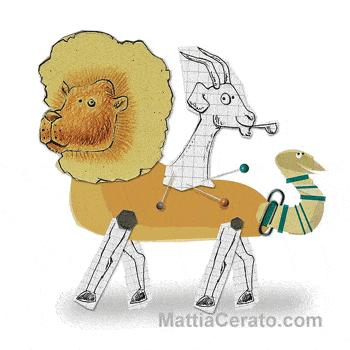
There are no Stickmen around these parts. Just Chimeras.

chimera Chimera vs. Stickman: The Difference Between Convergent and Divergent Thinking

The highest-level executive thinking, making of connections, and “aha” moments are more likely to occur in an atmosphere of “exuberant discovery,” where students of all ages retain that kindergarten enthusiasm of embracing each day with the joy of learning. Willis, Judy Research-Based Strategies to Ignite Student Learning: Insights from a Neurologist and Classroom Teacher (ASCD, 2006)

In Anne Flemmert Jensen’s paper, What do Children Need to Learn to Become Powerful Players in the World of Tomorrow?, for LEGO Education, she writes “children enrolled in preschools based on constructivist approaches do better in school in the long run (Miller & Bizzell, 1983; Marcon, 1992).” Loads of research support this finding. (See bibliography in Einstein Never Used Flashcards.)

Steven Tepper says there are several conditions necessary for creativity. You’ll see that it sounds a lot like a constructivist approach, a chimera education:

  • an atmosphere where collaboration thrives
  • diverse environments where there are adequate opportunities for cross-cultural exchange
  • interdisciplinary exchange
  • time and resources
  • an environment that tolerates and even encourages failure

We Need Both Divergent and Convergent

But, before you run off and demand an end to all convergent thinking, don’t. We actually need both convergent and divergent thinking. As creative thinkers, we must be able to use and integrate both.

“Creativity requires constant shifting, blender pulses of both divergent thinking and convergent thinking, to combine new information with old and forgotten ideas. Highly creative people are very good at marshaling their brains into bilateral mode, and the more creative they are, the more they dual-activate.” The Creativity Crisis by Po Bronson and Ashley Merryman

We just need MORE divergent thinking and much less convergent thinking in education.

Do you agree? disagree?

Did you know the difference before now?

Quiz yourself – can you spot which activities are divergent and which are convergent?

Coming up in this series:

  • Creativity in schools – finding it, advocating for it, and keeping it.
  • Examples of convergent and divergent learning (Hint: It’s not a Creativity Kits.)
  • ADHD and creativity
  • Standardized Tests
Selected References:
Bronson, P. , Merryman, A The Creativity Crisis
Flemmert Jensen, Anne. What do Children Need to Learn to Become Powerful Players in the World of Tomorrow?, LEGO Education
Healy, Jane. Different Learners, 2010
Ritchhart, R., Church, M., Morrison, K. Making Thinking Visible (2011)
Willis, Judy Research-Based Strategies to Ignite Student Learning: Insights from a Neurologist and Classroom Teacher (ASCD, 2006)
A big thank you to the artist who created the chimera, Mattia Cerato. Thank you for your brilliance!

Subscribe to Imagination Soup by email and get a FREE eBook with Pretend Play ideas.

You Might Also Like . . . 

 Creativity 101: A Parents Guidesmfacebutterfly Chimera vs. Stickman: The Difference Between Convergent and Divergent Thinking

beautifuloops lg 222x225 150x210 Chimera vs. Stickman: The Difference Between Convergent and Divergent ThinkingFinding Beautiful Oops Moments

 iStock 000003719551XSmall 150x210 Chimera vs. Stickman: The Difference Between Convergent and Divergent ThinkingPlayworks Makes Recess Awesome

If you enjoyed this post, make sure you subscribe to my RSS feed!

Related Posts


Quiz Yourself – Examples of Divergent and Convergent Thinking
January 10, 2012

Movement Matters for the Brain
June 14, 2011

Different Learners by Jane Healy
October 18, 2010

34 Comments


Jenny - Monkey Toes
4 months ago

(Reply)


I always thought this was over-thinking a question (I do it all the time) and have always thought I was insane for not seeing only one answer (still do). Not much in this world is definite to me – do you think it’s just a way of thinking – black & white vs black/white/gray?

Love this post!

Creativity 101 What Parents Need to Know
4 months ago

(Reply)


[...] my post, “Chimera and Stickman,” will break down the kind of learning environments that result in chimeras and stickmen and [...]

PragmaticMom
4 months ago

(Reply)


Put me down for the Divergent Thinking method! This is what creates leaders, inventors, innovators and people with creativity. I guess you CAN teach creativity! (or not kill it!).

crittersandcrayons
4 months ago

(Reply)


This is a great post and I’ll be sharing it on my page—- I know there are some folks that disagree with the Montessori Method but I happen to love it- and one of the reasons is that I feel that it encourages divergent, innovative, experientially-based thinking. I love the idea that my kids don’t learn off of a chalkboard but through their hands. Great post!

    Melissa Taylor
    4 months ago

    (Reply)


    Why do people say they disagree?

Jo Eberhardt
4 months ago

(Reply)


This is great, and provides some words and explanations for concepts that have been in my head for a long time. My overall disdain for, and concern with, the style of public education led to me searching out alternative options for schooling, because I didn’t want my bright, sensitive, creative son forced to lose his lateral thinking and problem solving approach to life. He starts at a Steiner Waldorf school this year.

One of the best statements I’ve heard to come out of that style of education is the school principal saying: “I was at a conference for educators, and there was a lot of debate about school curriculum. Someone said, ‘We just need to decide on one curriculum that we can teach at every school.’ My response was to say, ‘We don’t teach curriculum. We teach children.’”

    Melissa Taylor
    4 months ago

    (Reply)


    Amen to that! Thanks, Jo!

Karen Hewitt
4 months ago

(Reply)


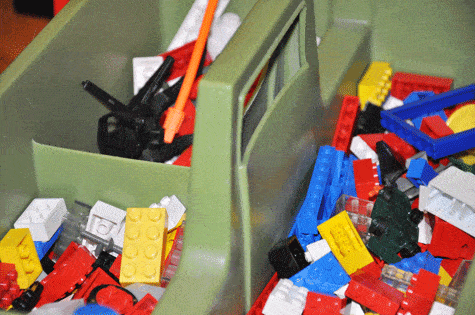
I see the increasing trend towards linear or convergent thinking in the recent debut by Lego of Lego Friends for Girls and the emphasis on one-solution kits. Not much gray area here. You are either pink or blue. You either complete the model in the diagram or you fail. Model making, or following directions, is interesting to many children, especially at a certain age. However, the increasing trend to market Lego (and other construction sets) as object specific kits or as gender specific toys rather than as an open-ended building sets is based mainly on the need for increased profits, not on what is best for the development for all children.

    Melissa Taylor
    4 months ago

    (Reply)


    did you sneak a peek at my post tomorrow? I use the Lego kits as an example – it’s almost impossible to get a box of Legos not in a kit! I checked at their store and they had 2 small boxes. Pathetic. And, I asked for something from their school / educational division – they said it was all online and you had to prove you were a teacher. Really? How is that in the best interests of kids?
    Melissa Taylor recently posted..Chimera vs. Stickman: The Difference Between Convergent and Divergent Thinking

      Carrie
      4 months ago


      The Lego Girls series is going to be the same way as all the sets in the stores. My boys have legos and Trios… they make the “design” once then once that gets broke down the pieces get incorporated into the herd and they start making creative things with them. From what I’ve seen the Lego Friends won’t even have the flexibility to create new things, it’s essentially a doll house in legos.

      I love this article and will be sharing this series with my staff. My hope is that all the preschool teachers can start to push up the convergent thinking and reverse some of the push down academics.
      Carrie recently posted..Children in day care too inactive according to providers

Daria
4 months ago

(Reply)


I’ve definitely noticed a trend that schools are becoming more supportive of divergent thinking than when I was in school. In the 70′s and 80′s the Socrates method of teaching was nearly universal, but we’re developing other ways to look at education – Montessori, kinetic learning, the “new math” – it’s a step in the right direction (I think).
Daria recently posted..Weekly Weigh In – #NSnation

    Melissa Taylor
    4 months ago

    (Reply)


    I’m happy to hear that — what school district are you in?

Gary Woolley
4 months ago

(Reply)


I would agree that we do more divergent thinking in our schools. Your discussion is like a breath of fresh air. Keep up the good work!
Gary Woolley recently posted..Tim Brown on Creativity and Play

    Melissa Taylor
    4 months ago

    (Reply)


    thanks for the support, Gary!

Aunt Annie's Childcare
4 months ago

(Reply)


Great post- thanks.

A very clever friend of mine fell foul of a similar question to the banana one when he was a child. He simply could answer the question ‘If you go to bed at 9pm and get up at 7am, how many hours did you sleep?’

…pause while you think of the problem inherent in this… are you a divergent thinker?…

He couldn’t answer it because he knew that he never went to sleep as soon as he went to bed.
Aunt Annie’s Childcare recently posted..Caught in a clash of parenting philosophies? 3 steps to sanity

Aunt Annie's Childcare
4 months ago

(Reply)


(that was meant to read ‘couldn’t’ not ‘could’- proofreading FAIL)
Aunt Annie’s Childcare recently posted..Caught in a clash of parenting philosophies? 3 steps to sanity

    Melissa Taylor
    4 months ago

    (Reply)


    what a perfect example, thank you for sharing that one. :)

The Monko
4 months ago

(Reply)


Love your post. Divergent thinking and innovative problem solving is definitely what I am trying to foster in my toddler. There will come a point when he’ll need to develop some convergent thinking in some areas, but I think its easier to develop that when needed, than to try and develop creativity at a later age if it hasn’t beed nurtured in the early years.
The Monko recently posted..Eating shapes

    Melissa Taylor
    4 months ago

    (Reply)


    this is exactly what the research is finding!

Quiz - Examples of Divergent and Convergent Thinking
4 months ago

(Reply)


[...] 10 Jan | No Comments » Now that you’ve learned or refreshed your memory on the differences between convergent thinking and divergent thinking, let’s look at the application in learning. Can you determine which is which? It’s [...]

Ali @ At home with Ali
4 months ago

(Reply)


Thank you for this post. I am trying hard to encourage divergent thinking in my children. The quote you used that children start school as geniuses in creativity… and lose it with each year of school (I apologise for my quick summary of quote) makes me so sad.
Ali @ At home with Ali recently posted..A miniature campsite

    Melissa Taylor
    4 months ago

    (Reply)


    it is sad – and scary, right!?

Jackie
4 months ago

(Reply)


Great refresher course… that brought back a lot of “Oh yeah, I learned that term in college.” Hopefully I haven’t forgotten the methods, but I think I did forget a few terms :) I absolutely agree that we need more divergent thinking in education and I think it is even more imperative for this generation. Most of their experiences won’t be using convergent thinking. If you think about it, networking, using the internet, social media, etc. all require the ability to not think linearly. It makes me wonder, though, if schools will catch up to this research before it’s too late. Sadly, I read an article in the Huff post education column yesterday about literacy in which the author claimed we are about 30 years behind using what research says about teaching reading and what is actually happening in many (not all) classrooms. Thanks for taking the time to provide this article. Hopefully it will help all of us to think about what we are doing!

    Melissa Taylor
    4 months ago

    (Reply)


    I wonder the same thing. Worry more than wonder I suppose.

Marty Safir
4 months ago

(Reply)


Beautiful post, Melissa, with great links to many important resources and additional information. My wife has steered me to understand many of these concepts and more. We are actively engaged in providing real ways to give kids a chance to practice creative thinking with lesson plans (all free for now) and more in the works. Looking forward to more in your series.

Of course, the banana could be green, too. Just sayin’.
Marty Safir recently posted..E. Paul Torrance Concepts Illustrated

Melissa Taylor
4 months ago

(Reply)


oh, how could I miss green? Maybe because I hate green bananas!?

Thanks, Marty!

The Key to Nurturing Divergent vs. Linear Thinkers | Beacon Villages
4 months ago

(Reply)


[...] Taylor of Imaginationsoup sums up the concepts of divergent and linear thinking quite [...]

Soup Scoop - Best Web Articles of the Week
4 months ago

(Reply)


[...] Web Articles of the Week 13 Jan | No Comments » Did you push yourself and your children to think divergently this week? I hope so. What did you do? (hint: leave comments to [...]

Teaching Individuals (Not a Curriculum) With a Workshop Approach
4 months ago

(Reply)


[...] continue education month here on Imagination Soup by looking at best practices for encouraging divergent thinking in [...]

Marjorie Sarnat
4 months ago

(Reply)


I was in first grade at Stone School in Chicago. Miss Mitchell gave us coloring pages of fruits and vegetables. I colored the grapes green and she marked a big X over them. When I asked the teacher what was wrong she said grapes are purple. I told her I had never seen purple grapes. We had only green grapes at my house. She said I should have colored the grapes purple and don’t argue about it. To me it was like saying I should have colored the lemons purple; it wasn’t my reality. But little did I know that the following day would be even more distressing. Miss Mitchell tried to convert me from being left handed to right handed! Grapes or no grapes, I wasn’t having it.

I enjoy and admire your website very much. You offer wonderful information about the importance of fostering creative thinking skills in our kids.
Marjorie Sarnat recently posted..E. Paul Torrance Concepts Illustrated

8 Reasons Why Fairy Tales Are Essential to Childhood
3 months ago

(Reply)


[...] Chimeras & Stickmen – The Difference Between Divergent and Convergent Thinking [...]

The Benefits, Basics, & Service Projects of Knitting for Kids
3 months ago

(Reply)


[...] Divergent vs. Convergent Thinking [...]

Teach Kids to Think About Their Thinking -- Metacognition
2 months ago

(Reply)


[...] Divergent Thinking vs. Convergent Thinking If you enjoyed this post, make sure you subscribe to my RSS feed! [...]

The Truth about Standardized Testing « Imagination Soup | Fun Learning and Play Activities for Kids
2 weeks ago

(Reply)


[...] More opportunities for divergent thinking in [...]


Leave a Reply

  Cancel Reply

CommentLuv badgeShow more posts

  • Let’s Connect!

    RSS Subscribe Twitter Facebook Pinterest Email

  • Hi From Melissa!

    Melissa Taylor Profile Photo Melissa Taylor is a mom and educator from Denver who is passionate about playful learning. Thanks for visiting the site!

  • About
  • Workshops
  • Contact
  • Pinterest

    Why You Need a MissiWhy You Need a Missisummer learning packPrintable summer rea
    Dollar store + IkeaNo, I can't!!50 inspiring art blogreat handout from t
    Never too young to sAwesome classroom liClear contact paperlearn with play
    Have a family adventthat artist woman: HThe Psychology of Co{10 Simple Ways to S
    Follow Me on Pinterest More Pins

OTHER FUN INFO

iPad Apps

Chapter Books

Picture Books

Writing Fun

Education

Games


Copyright © Melissa Taylor - Design by Aimee Giese