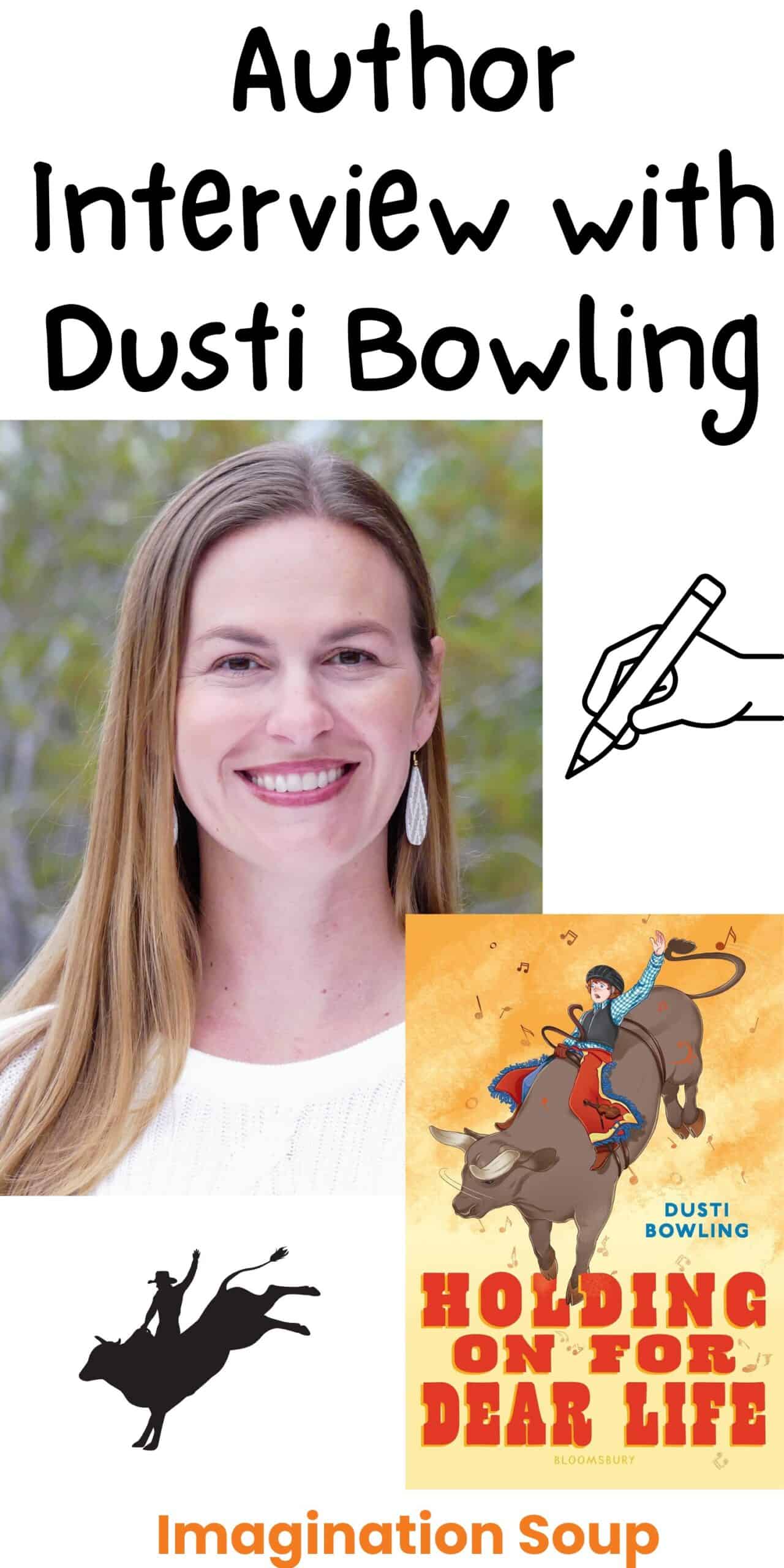
Author Interview with the Incredible Middle Grade Writer Dusti Bowling
This post may contain affiliate links.
Ya’ll, this book. This author. These answers. Wow. Let me explain…
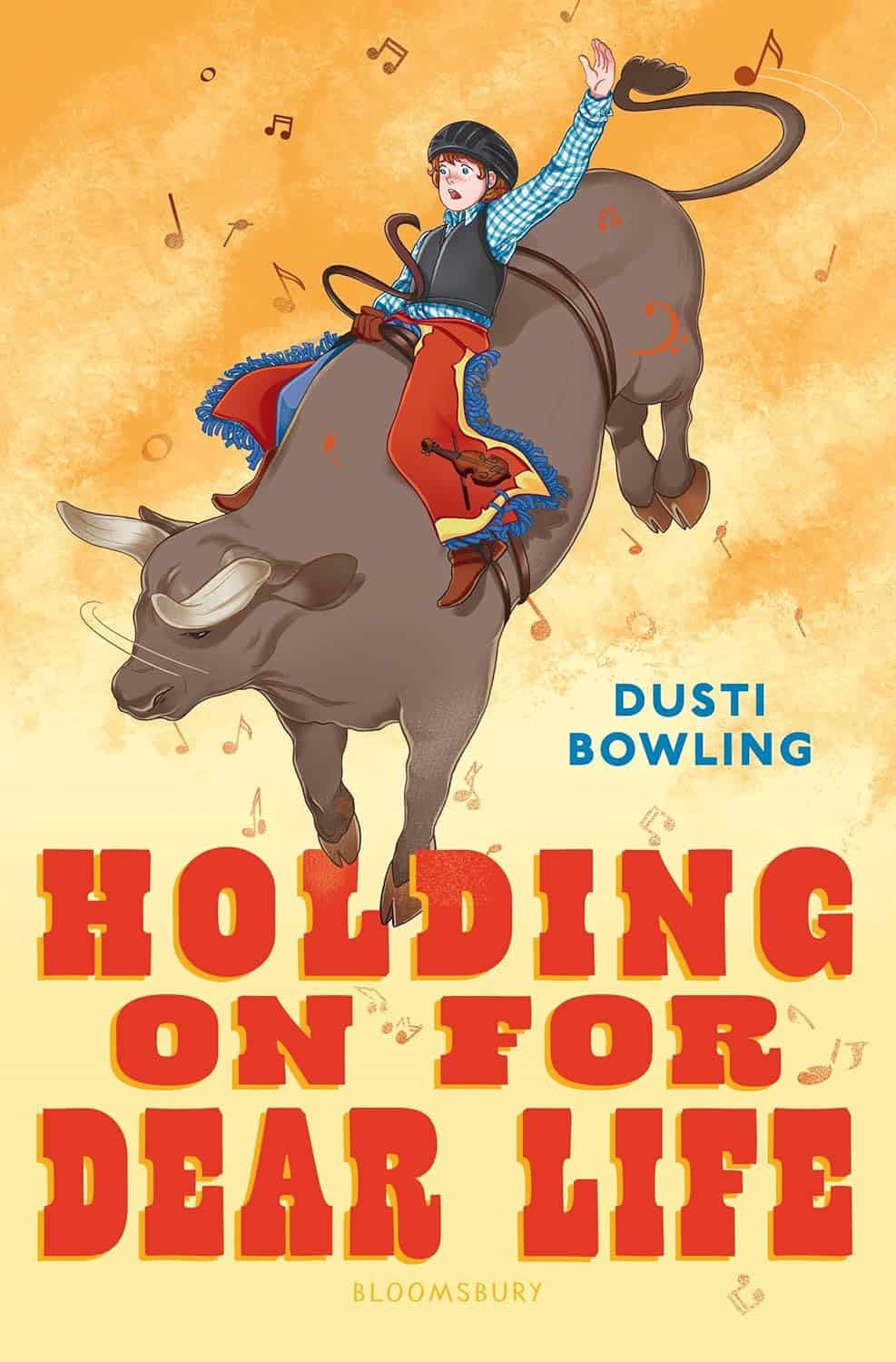
Dusti Bowling, one of my FAVORITE middle grade authors, just released yet another outstanding, heart-tugging, memorable book that captivated me from beginning to end: Holding on for Dear Life.
So when her publicist asked if I would interview her, I JUMPED at the chance. (I had SO many questions.)
In fact, there were so many questions that I told Dusti to pick and choose the questions. But wouldn’t you know it, she answered them all. (Talk about generous and amazing!)
Our interview, which we did via email, shares how she thought of this new story idea, her writing process, her advice for writers, why she chose the topics in the book, and MORE. It’s packed. You will feel like you know Dusti personally after reading her responses to my interview questions.
Thank you so much, Dusti! I’m thrilled to have met you in person and to share this interview with Imagination Soup readers.
And please buy Holding on for Dear Life–it’s truly amazing!
Author Interview with the Incredible Middle Grade Writer, Dusti Bowling
MELISSA: I love HOLDING ON FOR DEAR LIFE and the unique world and characters you created. How did this story come about?
DUSTI: This story was inspired first and foremost by the character of Canyon and his relationship with his father. I had long wanted to write a story about a child dealing with an alcoholic parent because I grew up with two alcoholic parents, and I know countless kids are living through that right now. I wish I’d had books when I was a kid that addressed this issue so I could see that I wasn’t alone in my experience.

Secondly, I wanted to write about rodeo because it’s so incredibly popular where I live, and there are very few middle grade books out there that have to do with rodeo. When deciding on a sport for Canyon, it was an easy choice to settle on bull riding for a couple of reasons. One: Bull riding is very exciting, of course. And two: Bull riding is extraordinarily dangerous. I’ve long been concerned about children participating in dangerous sports and the lifelong effects they’ll face—effects, it turns out, many children aren’t even aware of.
MELISSA: What was your research process like for the brain injuries of CTE and TMIs, and bull riding?
(*I was working at the Denver Stock Show and met Tuff right after the Bodelicious accident that broke his face into pieces – it left a lasting impression, let me tell you. I liked that you included that true story in your fictional story.)
DUSTI: I really enjoyed the research for this book, maybe more than for any other book I’ve written, because it mostly consisted of going to a lot of rodeos (which are always entertaining) and watching a lot of professional bull riding. For part of my research, I attended a qualifying round for the Junior World Finals that takes place in Las Vegas every year. I had the opportunity to interview several of the young bull riders and watch them ride. It was both exciting and terrifying. Several got injured, and one boy was even taken away in an ambulance toward the end of the day. It was then that I knew I needed to focus on the risks of bull riding a lot more in my story. Part of the problem with trying to accurately present the rate of injuries and CTE specifically in bull riding, though, is that it’s believed to be heavily underreported.
During the writing of this book, my daughter actually got a severe concussion while skiing on New Year’s Eve. She had terrible memory loss and couldn’t remember Christmas, what she’d been doing to give her the concussion, or even how old she was. For the first 24 hours, she kept asking us the same questions over and over again hundreds of times. It was very scary. A nurse in the hospital tried to comfort us and told us her own son had already had five concussions just that year. Turns out, he was a bull rider. As soon as we knew our daughter was going to be okay, I sat down and wrote the main concussion scene for Canyon. This was the best research I hope to never do again!
MELISSA: What do you hope readers take away from this story?
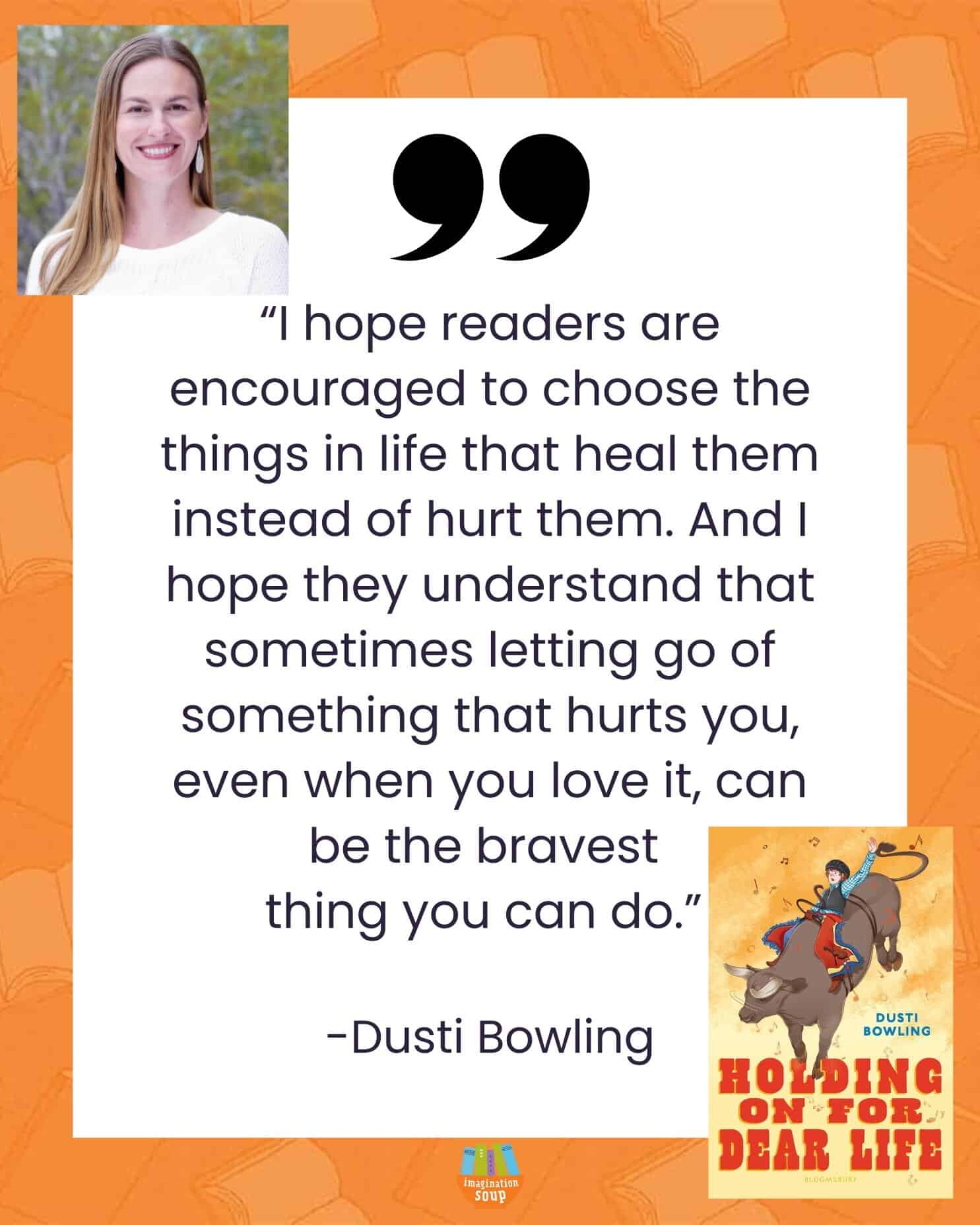
DUSTI: I hope readers are encouraged to choose the things in life that heal them instead of hurt them. And I hope they understand that sometimes letting go of something that hurts you, even when you love it, can be the bravest thing you can do.
MELISSA: I looked up the statistics and learned that a quarter of kids have a parent with a substance use disorder. This is your second book that includes a parent with a substance abuse problem. Why was it important for you to include this?
DUSTI: I think it’s important to include things that kids are really going through. As you said, a quarter of kids are living with an addict. I grew up with two parents who were both addicts, and yet I never saw this in any of the books I loved, and so I felt very alone in this difficult experience. The scene in the cemetery with Canyon and his dad was extremely painful for me to write because something very similar happened to me when I was a child. My father got horribly drunk one night and threw me and my little brother in the car in the middle of the night. He then drunkenly drove us to my grandfather’s gravesite, where he had a complete breakdown. I was so scared we were going to die that night. Traumatic experiences like this can stay with us forever, but I’m glad I was able to turn this terrible thing into something good—a book I can share with children going through their own trauma. I hope they feel comfort in knowing that I experienced it, too. In knowing they’re not alone.
MELISSA: The ending was perfect. Since endings are often the hardest thing for me to write in my own stories, it made me wonder if you find certain parts of the writing process/product harder than others.
DUSTI: I won’t even write a story unless I know the ending, so I find endings no more difficult than the rest of the story, though nothing about writing is easy for me. I don’t know if I can pinpoint one part of the writing process being more difficult than others because it’s all extremely difficult for me! I think simply finding the balance of good characters, exciting plot, and a meaningful theme can be extremely tough.
MELISSA: What is your writing process like? Do you outline? Get the main character first? Story idea and then pants it?
DUSTI: I am definitely a planner for the most part, and I usually think about a story idea for years before I finally feel ready to outline it. I would say most of my story ideas start with the character. The characters are the most important part of the story, and as I get to know them in my mind, they usually drive the plot. I recently had an idea that started with plot, though, and my first draft has a lot of character issues I need to work on.

MELISSA: Where do you find story ideas?
DUSTI: Story ideas can be found anywhere. I find them in the desert, in my childhood experiences, in people I meet and love and have lost, in the issues I care about. Anything can turn into a story, as long as you’re passionate about it.
MELISSA: What is your best advice for growing writers?
DUSTI: My best advice is always to read a lot of books. I never studied writing in college and didn’t even start writing until I was nearly thirty years old. The only reason I was able to do it is because of the thousands of books I’d read in my life. Reading wires your brain to be a writer in addition to so many other benefits. I’m lucky, though, that I grew up without all the screens kids have today. I didn’t even get my first computer until I was eighteen years old. I know it’s difficult to choose reading over YouTube, but it’s an important choice for your writing ability, mental health, and brain!
MELISSA: What is your best advice for adults who support growing readers?
DUSTI: Let them read what they want! How will children grow to love reading if they’re not allowed to read what they want? Provide them with plenty of reading choices and give them the time, space, and freedom to read what they like, even if that means a lot of graphic novels. We let our daughter read almost nothing but graphic novels for a few years, and now she loves to read everything.
About Dusti Bowling
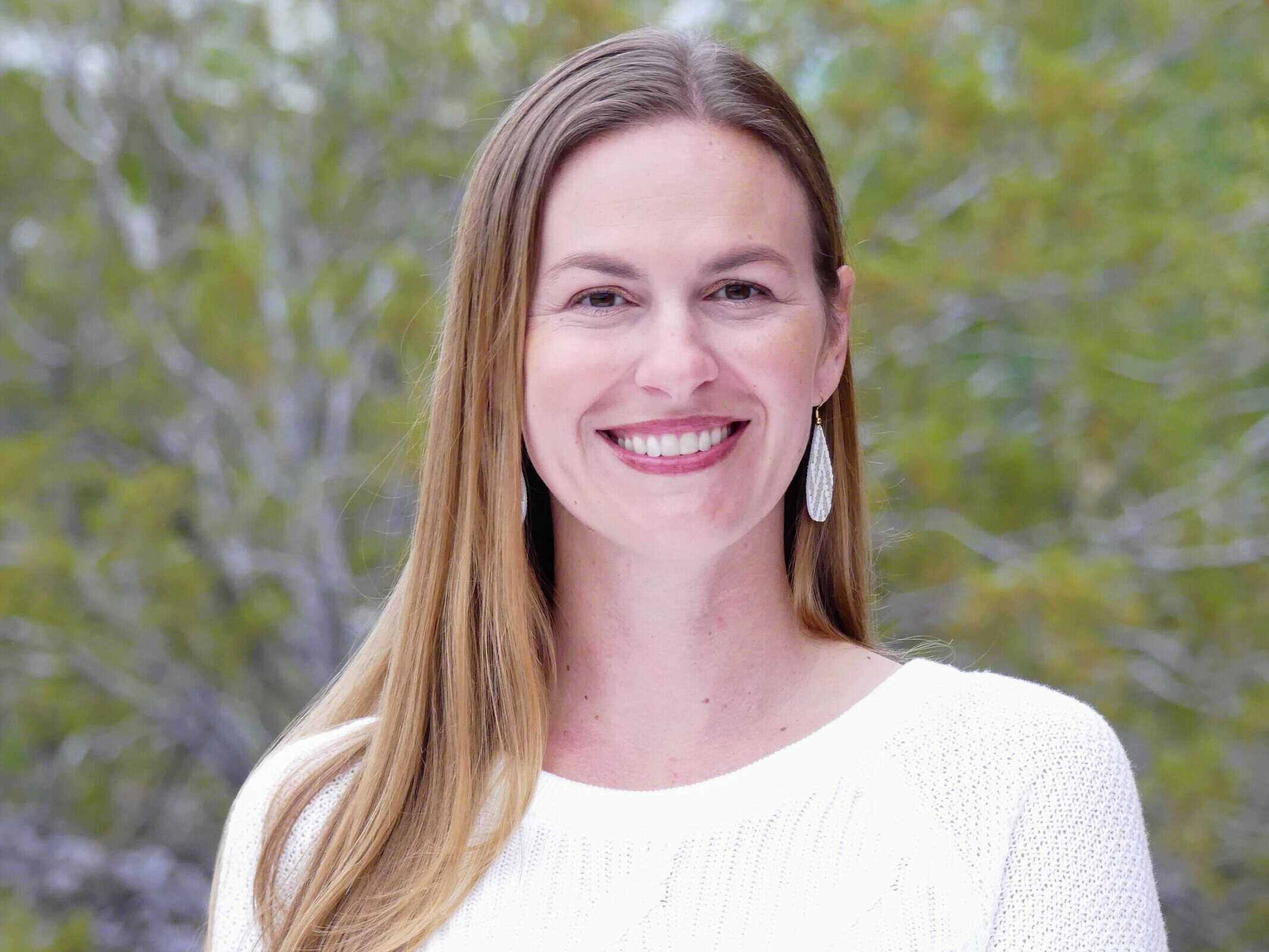
Dusti Bowling is the award-winning, Publisher’s Weekly bestselling author of ten middle grade and chapter books. Her books have garnered fifteen starred reviews and have won multiple awards including the Reading the West Award, the Sakura Medal, a Golden Kite Honor, the William Allen White Children’s Book Award, and have been nominated for over fifty state awards (having won several). Her books are Junior Library Guild Gold Standard Selections and have been named best books of the year by the Chicago Public Library, Kirkus, Bank Street College of Education, A Mighty Girl, Shelf Awareness, and many more. Follow her on Instagram @dustibowling.