48 Comments
Not everyone believes in the importance of fairy tales for kids. In fact, 25% of parents recently surveyed said they wouldn’t read fairy tales to a child under five years old because they didn’t teach a good lesson or were too scary. Many of you shared your opinion about this on Facebook and please comment here, too – I want to hear your thoughts!
The fairy tale survey, quoted in this UK’s Telegraph article shared the top ten fairy tales parents don’t read and why. Reading through the list of reasons, I can only conclude that these parents have lost their reasoning skills –completely. For example the reason not to read Goldilocks is that sends a message to steal. Hardly. If anything, the message is don’t break into houses because a family of bears might live there.
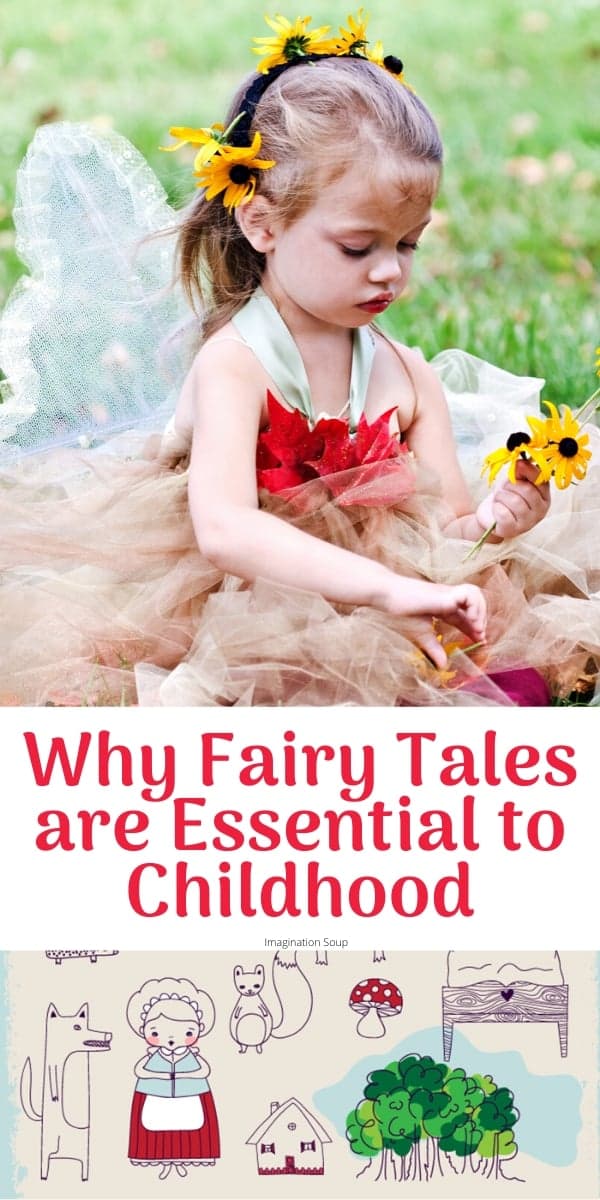
I want to look at why fairy tales are important for kids; why they’re essential stories for childhood.
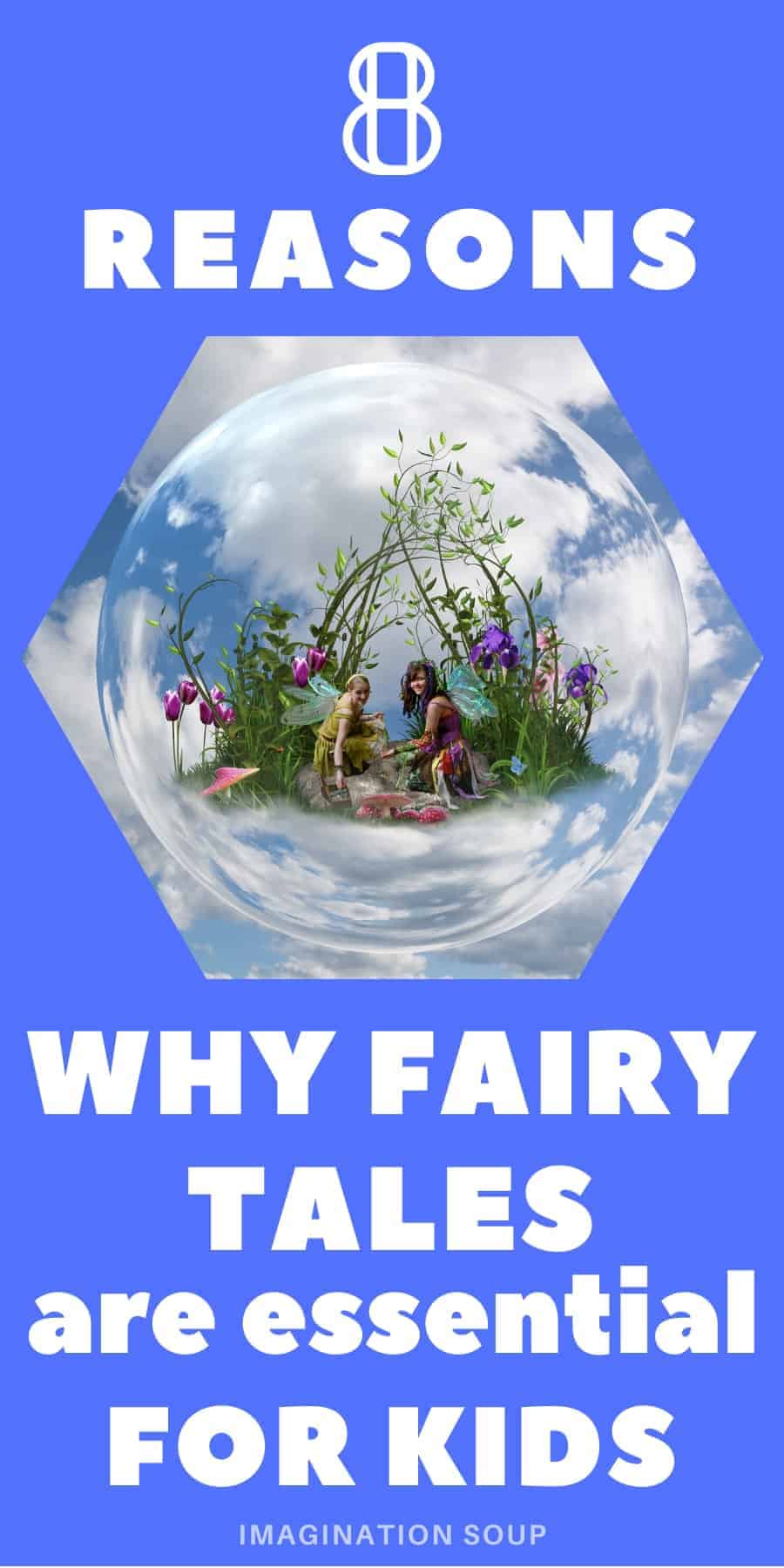
The Importance of Fairy Tales
“If you want your children to be intelligent, read them fairy tales. If you want them to be more intelligent, read them more fairy tales.”
― Albert Einstein
1. Fairy Tales Show Kids How to Handle Problems
We learn from the characters in stories, even as adults. They help us because we connect to our own lives, dreams, anxieties, and consider what we would do in their shoes. Fairy tales help children learn how to navigate life. (Bettelheim, B. Uses of Enchantment: The Meaning and Importance of Fairy Tales.)
“Fairy tales do not tell children the dragons exist. Children already know that dragons exist. Fairy tales tell children the dragons can be killed.”
― G.K. Chesterton
2. Fairy Tales Build Emotional Resiliency
Fairy tales show real life issues in a fantastical scenario where most often the hero triumphs. (Except in Grimm originals.) Children need to discover in a safe environment that bad things happen to everyone. Because guess what? No one in life is immune from challenges — so we need to build capacity in our children. Do we build emotional muscles so our children can hang on during tough times or do we shelter our kids, protecting them, leaving them so weak they can’t handle anything requiring strength?
3. Fairy Tales Give Us a Common Language (Cultural Literacy & Canon)
Neil Gaiman writes, “We encounter fairytales as kids, in retellings or panto. We breathe them. We know how they go.”
4. Fairy Tales Cross Cultural Boundaries
Many cultures share common fairy tales like Cinderella, with their own cultural flavor. We read the versions and know we all share something important, the need to make sense of life with story, and the hope for good to triumph over evil.
5. Fairy Tales Teach Story
Fairy tales are understanding the basics of story — setting, characters, and plot (rising action, climax, and resolution) as well as the difference between fiction and non-fiction. Once a child understands story, it supports his ability to make predictions and comprehend other stories he’s reading.
6. Fairy Tales Develop a Child’s Imagination
“When I examine myself and my methods of thought, I come to the conclusion that the gift of fantasy has meant more to me than any talent for abstract, positive thinking.”
― Albert Einstein
7. Fairy Tales Give Parents Opportunities to Teach Critical Thinking Skills
I absolutely hate Disney’s The Little Mermaid. A girl abandoning her life for a boy is rubbish and no kind of role model for my daughters. Even the original version shows a weak woman who dies for the man — I don’t like it. (But at least she suffers the consequences!)
But.
It doesn’t mean I won’t let my kids read the mermaid story. Sheltering doesn’t give my kids critical thinking skills. Exposure and guided conversation does! (Maybe with a few groans from the peanut gallery.)
8. Fairy Tales Teach Lessons
Use fairy tales to teach morals and lessons. What can you learn from Goldilocks? How about Cinderella or Jack and the Beanstalk?
So, are fairy tales too scary for kids?
Sometimes.
You need to consider a child’s age and developmental stage. We don’t read a two-year old the original Rapunzel where the prince is blinded and bloodied because the child won’t understand it anyway. Use your judgement as a parent. Let your children use their judgement, too — they’ll be able to say if they think the story is too scary or not.
You need to consider time of day to read the fairy tales. Perhaps some fairy tales aren’t meant to be bedtime stories. So, read them at lunch!
Just don’t ban fairy tales from your child’s life forever just because some are scary or politically incorrect. You can easily find modified versions if that works better for your child and your family.
What are your thoughts about fairy tales?
What are your favorites?
“Though now we think of fairy tales as stories intended for very young children, this is a relatively modern idea. In the oral tradition, magical stories were enjoyed by listeners young and old alike, while literary fairy tales (including most of the tales that are best known today) were published primarily for adult readers until the 19th century.(complete:http://www.endicott-studio.com/gal/galWi…)”
― Terri Windling
Read more: Fairy Tales – Recommended Books and Activities
Subscribe to Imagination Soup by email and get a FREE eBook with Pretend Play ideas.
You Might Also Like . . .
Dr. Seuss Activities – Read Across America
Mixed Up Fairy Tales for Family Storytelling
Chimeras & Stickmen – The Difference Between Divergent and Convergent Thinking


Melissa Taylor is a mom and educator from Denver who is passionate about playful learning. Thanks for visiting the site!


48 Comments
HAVE YOU READ ‘The Witch Must Die’. A wonderful book telling of the joys and uses of folk and fairy tales….original versions and Disnified versions! All have a purpose and a joy to them! Read Baba Yag; a Russian fairy story (one of my favourites!).
no I haven’t but it sounds like I need to! Thanks.
I love this article and completely agree! With that said I could really use some help finding books and age appropriate stories for my almost 4 year old… Can you help? Thanks!
Dawn- Yes, tomorrow! Stay tuned . . .
[...] 8 Reasons Why Fairy Tales are Essential to Childhood [...]
Great thoughts, Melissa and I so agree.
This Monday we had a princess and angel party at home and incorporated some fairy tale reading. It was super duper fun and at the same time some quiet moments of engrossed reading!
I’ll be doing that post soon.
Rashmie @ Mommy Labs recently posted..Brown Paper Bag Painting and More on ‘Made with Love’ ‘me-time’!
Hi Melissa,
Totally agree with what you say here about the importance of Fairy Stories. It’s a ‘safe’ way to practice a fantastic range of life-skills. Emotionally: Empathy with the character’s journey, language to be able to talk about their own feelings, so Self-Expression. Intellectually, visualise and follow something that is not in their concrete world. Spiritually/Morally looking at the choices the characters make… It’s powerful stuff!! What’s great is that as well as being ‘good for them’ it’s low cost, fun and can be a lovely sharing, connecting experience! Thanks for this great reminder
Melissa, this is powerful….you might find this interesting: http://www.telegraph.co.uk/education/educationnews/8378975/Parents-who-shun-fairytales-miss-chance-to-teach-children-morality.html
Horaay, someone who thinks the same as me! I was so saddened to hear the negative comments about parents not sharing traditional fairytales with their youngsters. It kind of rubbished my upbringing and that of my childrens younger days as that was what I read to them too. Thank you for re- enforcing how brilliant Fairytales are!
Tracy Roberts
What a travesty that the richness and magic that we were surrounded with is being denied to generations of children. Through them children learn about the power of good over evil, morality, tolerance of other cultures. Most of all fairy tales teach about hope, They also teach although life is full of difficulties and challenges , good people with good intentions do make it through.
In a world where we are surrounded by hopelessness and violence surely these wonderful stories that have stood the test of time should be relished by young and old. Time to encourage children to value their imagination and belief that magic can and does happen. They will need those skills throughout their lives if they are to be resilient human beings who care for all creatures great and small.
We tend to stick to the modernized versions of the tales. They aren’t as scary.
Yes! Fairy tales have so much potential to teach young children, especially when a conscientious parent or teacher is there to guide it. I like how multiple versions of fairy tales are readily available now. It’s fun to compare and contrast them with students.
I think fairy tales are a great way to introduce children to story and imaginary worlds. My kids loved them, especially myths from other cultures. One cautionary note is to watch out for the ones where girls are saved by a man. Most of the Disney adopted stories fall into this category and they can collectively send the wrong message to little girls. My daughter and I loved a chapter book called The Ugly Princess and the Wise Fool by Margaret Gray. It’s a story about a princess who was born “not beautiful . . . [nor] even remotely pretty.” The kingdom is in shock but everyone comes to adore the buck-toothed princess and she accepts her appearance until the handsomest prince in the world comes looking for a pride. This book turns the traditional fairy tale princess plot on its head when the princess gets her wish for beauty and then regrets her choice. Highly recommend it!
Meryl recently posted..We LOVE to Play
Oops, the prince was looking for a “bride” not a “pride”!
Meryl recently posted..We LOVE to Play
Absolutely. I’m always on the look out for great non-western culture stories. It’s interesting to hear the different messages shared in myths and legends from Asian, American Indian and other cultures.
[...] Books, Chapter Books, and Writing Ideas 23 Feb | No Comments » Yesterday I explained why we must read fairy tales to our children, responding to the thinking that fairy tales are too scary, too politically [...]
I love this article! I completely agree that we should be reading fairy tales to our children. I learned in a psychology class that it is okay for children to be scared at a young age, when it’s age-appropriate content (read: no chainsaw massacres for 5 yr olds), and they are in a safe environment. It stimulates their brain, and they learn to recognize and regulate the emotions associated with fear in a healthy way. Parents can be far too overprotective, which I fully understand, but we’ve got to let our kids experience things! Obviously, if your kid is overly sensitive, or they get so scared they start crying, then maybe back off on the fairy tales, but not as a rule!
Thanks for writing this.
Daniél
Daniél recently posted..Take no heed of me
thanks for the comment!
Thank you Melissa. I have a 3 1/2 year old who loves dressing up as Disney princesses, loves to play with her Snow White figures and Little Mermaid toys but is absolutely petrified of the villains in all the stories. She will not watch them on DVD and we had a stand off at the Christmas pantomime when she refused to even enter the theatre to see Snow White because of the evil queen, and £25 of tickets went down the drain. (not a happy mummy!)
So I have come close to throwing out the fairy tale books from our house, worrying about nightmares and emotional damage to my precious girl, but my husband and yourself have convinced me to stick with it. We don’t watch the movies or listen to the story tapes (scary music, scary scenes, scary voices), but we do continue to read the books, and play princesses. And yes, I do now think it is good to teach children that bad people do exist, bad things do happen, but that good does too, and that good triumphs over evil… making sure of course that she is protected from too much fear and heartache.
I hear you, Hazel — my kids got scared at Disney on Ice b/c they’d never been exposed to the Disney versions of the fairy tales and the bad ladies are freaky! I will say that it’s curious that my kids never got scared with the fairy tales from books – could be the difference in versions or the difference in visuals / imagination. Disney doesn’t leave much too the child’s own imagination — which at a young age is much less sophisticated and scary.
I agree with your comment about visually seeing a villain and imagining one. For example, my oldest son LOVES the first Harry Potter book and has read it several times. I was very concerned that this would be too scary for him. However he has no frame of reference to create the same images in his mind that my mind creates when I read the book. When he imagines a 3 headed dog, he does not picture the movie version, but his Nana’s dog with three heads. But he gets very frightened in most Disney movies and asks us to skip all of the intense scenes with the villains. That is the beauty of reading fairy tales. The listener filters it and creates a reality they are safely prepared to deal with, the dragon they feel able to slay.
Danielle recently posted..The Day it Rained Hearts
I really love this, but, I have to say one little thing. I disagree about The Little Mermaid. While I completly agree that abandoning your life for a boy is just plain silly, I think the idea there goes deeper. Ariel never felt like she belonged in her world. I think her decision is less about a boy, and more about having the courage to go beyond her comfort zone, and find a place that she felt more at home. What a brave soul it takes to break out of the expectations everyone else holds you to!
That could be the eternal optimist in me speaking, though. I guess there’s always another way to look at things!
nice, Meghan, thanks for sharing!
thanks for writing this valuable post! As you know my whole day is spent reading Fairy Tales to kids on my website. The lessons of these age old stories stand the test of time. They present important moral lessons. I am so glad you took issue with the UK survey as I was also appalled when I read it. I love that fairy tales are about ordinary people, from boys and girls to women and men, that find themselves caught up in a magical event. And the fact that there is a strong difference between the good and evil characters. I shared your post on my Facebook Page too.
thanks, Mrs. P!
LOL – I let my kids watch prime time TV. Fairy tales are tame!
Daria recently posted..All American or International ~ Which is Best for Kids?
I had read all of Andrew Lang’s fairy tale books by the time I was 7 or 8. I believe they increase a child’s sense of wonder and imagination, and widen their worldviews beyond their immediate surroundings. “East of the Sun, West of the Moon: was always one of my favorites. Fairy tales led to science fiction and fantasy reading. No one can say that Tolkien, which I read first at 12, could do anything but expand a child’s imagination and sense of responsibility for one’s actions. This is one of the important aspects of fairy tales, in my opinion. And I cannot stand what Disney has done!
thanks, Lucy. I agree.
Thank you for writing this. I’ve been genuinely frightened – oh, not by fairy tales, but by the number of supposedly sentient adults who think their children need to be protected from them.
I am the world’s biggest fairy tale fan – but even though I love Disney, I hate what his screenwriters did to our fairy tales. The little mermaid DIED, and Cinderella’s stepmother got a punishment appropriate to her horrendous treatment of a child. Etc.
Unabridged fairy tales rock. The abridgements not so much.
Mamacita recently posted..The Presidents Speak
Fairy tales have deeper levels than it appears. In the Emporer’s New Clothes, usually children are the ones that feel “exposed” and inferior, but innocence (a child) sees the deception. The 3 Little Pigs keep trying solutions. Goldilocks learns about boundaries/private spaces. Cinderella’s dreams are so powerful they do come true. Snow White and the dwarfs learn about friendship/service. Ali Baba discovers the power of words. Jack confronts the fear of the unknown, faces the challenge of leaving, and overcomes the ‘giant’ of greed, anger, & hoarding. Beauty/love are often disguised; we see only the Beast. Pinocchio has to learn self-control and not just to dance on the strings of impatience, jealousy, desire, approval of others. Rapunzel found both good and bad as she ventured away. And just like Sleeping Beauty, kids need time to grow and mature; quiet times to reflect are important. Kids try and figure out the ‘light of knowing’–reading, writing, numbers, etc that adults know–just like Aladdin. Fairy tales are
enlightening (I did a whole series on my 123kindergarten blog last March. I was so delighted to see yours!!) P.S. To kids, mothers do seem wicked: we make them go to bed, eat their veggies, pick up their toys. Sigh, we’ve been getting the bad rap for centuries.
Barbara Allisen recently posted..Readiness for Kindergarten – Hearts & Other Parts, Part 3
Barbara,
I can’t wait to visit your blog and read that post! Thanks!!
[...] On this note, here’s a beautiful article by Melissa at Imagination Soup titled “Why Fairytales are essential to childhood“ [...]
What a lovely article – and site generally – thank you!
Like Meghan, I also disagreed with some of your thoughts on the Little Mermaid. I also disliking the Disney versions of pretty much everything, and hate that they changed the end of that one so very much. But I don’t think Andersen’s original Mermaid was weak for choosing to die at the end. When she asked for legs, she was warned of the potential consequence: death. And at the end, she chose to accept that, rather than harm someone else to escape the consequences of her actions. That is absolutely a lesson I want my kids to know. Doing the right thing, not using someone else to shield you from what you’ve done. That’s not weak.
Thanks for the post, it did make me think.
Thanks, Mika- I actually just hate the Disney version of the Little Mermaid but like Anderson’s for the reason you mentioned – it’s a real consequence, just like real life. Thanks for the thoughtful comment!
Fairy tales hold valuable lessons for us all… children and adults alike. I think that as with everything – activities, toys, movies, etc. – books, including fairy tales need to be appropriate for the child. You start at a young age with stories such as The Three Little Pigs progressing to stories such as Rapunzel.
Overall, I much prefer the original versions to Disney because to be blunt, Disney is completely and thoroughly commercialized. They are great movies but the essence of the fairy tale has often been wiped out to cater to the masses.
Suzi recently posted..We are Explorers
Thank you for this! Fairy tales are not meant to be fluffy happy stories, they are cautionary tales where awful things sometimes happen, and they don’t all have happy endings. They are also not perfect. I have read some Grimm tales and said “well that was a terrible story”. But it prompted discussion.
I was so annoyed when I read that Telegraph article last week, and like you the ‘Goldilocks promotes stealing’ comment floored me. I don’t know what version of the story they were reading. As far as the Disney fairy tales, for me they prompted me to read the original versions, and to read them to my kids. Parents have to talk to their kids, this is where they get squeamish. It is easier to put them in front of movies and tv. I believe that many people who say that they won’t read *enter story title here* to their kids probably don’t read to their children much anyway.
Jennifer recently posted..Reading, Writing Blog Posts, and The Woman In Black
[...] loved this article on 8 reasons why fairy tales are essential to childhood–it includes one of my favorite Einstein [...]
Thank you for this post. It is such a shame that some parents do not want to read fairy and folk tales to their children. I think they teach valuable lessons, and equally, expand children’s minds and imaginations by introducing them to fantasy worlds.
I read the article from the UK and one in the Huffington Post, they obviously missed the real strength and heroism in Beauty and the Beast. It was Beauty who, with true strength, saved her father and ultimately freed Beast from his monstrous prison. And how did they miss the part in Hansel and Gretel where Gretel stepped up to the plate (pun intended) to save Hansel from the lunch menu at the Witches Cottage Café? In my opinion fairytales are as important to literature today as they were in the past. Modernizing them a bit to better reflect our social progress which just makes sense. We still do laundry these days but I’m not going to bang my clothes against a washboard.
Fairy tales, fiction, non-reality, teaches children (when they discover reality eventually) that adults intentionally delude them, cannot be trusted, are merely perpetuating the lies the adults themselves were taught when vulnerable: Santa Claus, the tooth fairy, God, the Devil, Heaven, Hell. Lack of reality, lack of logic, lack of truth thus handed down stupidly generation to generation, defeating any chance of improvement, hope, end of deceit.
I totally disagree and furthermore, have never seen evidence of this grand delusion in children’s lives. It’s very important that children learn the difference between fiction and non-fiction, have the chance to develop their imagination, and are given stories to make sense of their lives.
[...] 8 Reasons Why Fairy Tales are Essential in Childhood ** This post went viral!! [...]
I think Fairy Tales are like the Bible … you must know to understand cultural references.Plus I love the new spins on fairy tales. Some are really funny and most are great! My son loves The Princess and the Peanut, An Allergic Fairy Tale.
PragmaticMom recently posted..Friday Find: 10 Ways to Use Sports to Teach Math from Babysitters.net
I think Fairy Tales are like the Bible … you must know to understand cultural references.Plus I love the new spins on fairy tales. Some are really funny and most are great! My son loves The Princess and the Peanut, An Allergic Fairy Tale.
PragmaticMom recently posted..Friday Find: 10 Ways to Use Sports to Teach Math from Babysitters.net
You’ve got some points there, but I totally disagree with you about Disney’s “The little mermaid”. Where do all these Ariel haters come from? Has the writer of this article never been in love, or done something for someone they loved? I don’t see how someone, who defies her father, takes very dangerous risks and eventually helps defeating the villain, can be a “weak woman”. Ariel maybe didn’t do the smartest thing all the time. For example, she should never have trusted Ursula. But she wasn’t weak. Why would wanting to be with the man she loves make a woman weak? I can already hear people crying “But how could she love him? She didn’t even know him!” And there might be some truth in that. But this is a Disney movie based on a fairy tale. Love at first sight was only to be expected. And didn’t Ariel and Eric have to spend some time together before they could get a happy ending? So I think we should cut Disney some slack on that one.
And the orginial version is just sick. And I don’t mean that because the mermaid wants to be with a man, but because she has to kill him or die. Hans Christian Andersen could write some weird and gruesome stories.
[...] of her blog down to her Reading section. In particular, I wanted to share with you a post about 8 Reasons Why Fairy Tales Are Essential to Childhood. Although supporting her stance with quotes from wonderful authors like G.K. Chesterton and Neil [...]
We included a link to this article on our Mommy and Me Three Little Pigs themed Book Club this week. I appreciate your wonderful insights.
http://preschoolbookclub.blogspot.com/2012/03/three-little-pigs.html
[...] Might Also Like . . . 8 Reasons Why Your Children Should Read Fairytales If you enjoyed this post, make sure you subscribe to my RSS [...]