What Is a Constructivist Classroom?
This post may contain affiliate links.
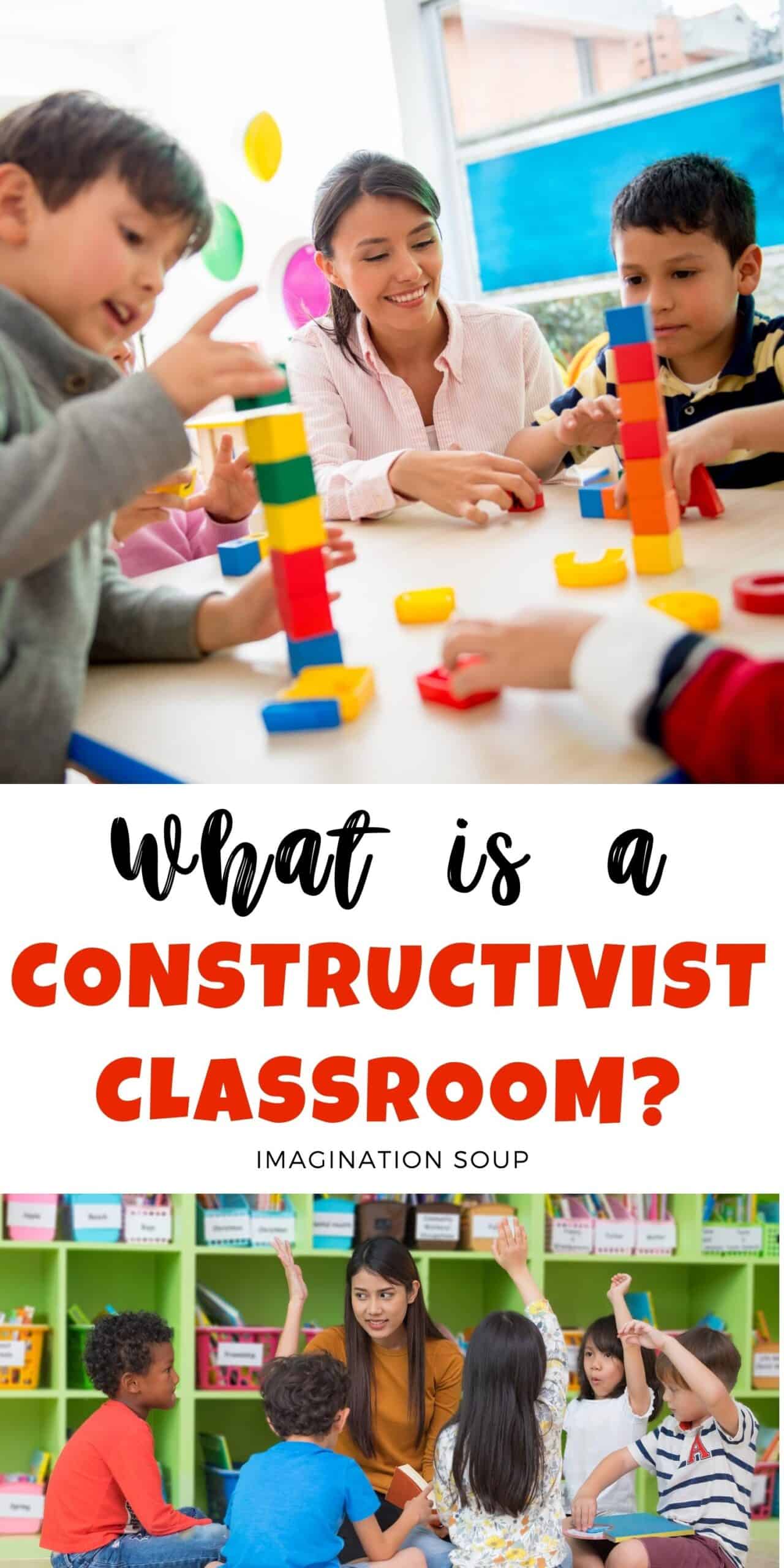
There is plenty of research to prove, that constructivist education is the best way for learners to learn. Research (see my bibliography below) shows that constructivist learning is congruent with how the brain learns.
Constructivist education is when learners actively construct meaning by building on background knowledge, experience and reflecting on those experiences.
Said in another way, constructivist learning is when “learners are given the freedom to think, to question, to reflect, and to interact with ideas, objects, and others—in other words, to construct meaning.” –Brooks and Brooks.
It’s “the idea that development of understanding requires the learner to actively engage in meaning-making.” – Brader-Araje & Jones (2002)
I’ve made a little comparison chart to make it more clear.
| (1950s?) Old-School Classroom | Constructivist Classroom |
| Teacher directed (didactic dissemination of information) | Learner-centered. Teacher as facilitator – students construct knowledge through critical thinking, manipulatives, primary resources, and hands-on activities. |
| Student works independently. | Student works collaboratively in groups, independently or in partners. |
| Small parts first. Big idea at the end. | Big idea first. All parts support big idea. |
| Correct answers are the goal. | Thinking and support of thinking are the goals. |
| Assessments are tests; separate from learning task. | Assessments are observation, conferences, daily work, portfolios and included in learning tasks. |
| Worksheets, workbooks, basal readers. | Books, journals, real-world situations, workshop approach. |
| Teacher evaluator. | Self-reflection, student evaluator and teacher evaluator. |
| Product based learning: All students will learn on demand the same thing at the same time aka. One-size-fits-all approach. | Process based learning: Learners create meaning and context by exploring new ideas and experiences, generating hypotheses, problem solving. |
| Teacher talks to (at) students; students expected to listen and absorb knowledge. | Teacher-student dialogue through conferring, questioning, and wondering. |
| Teacher makes all the decisions. | Shared responsibility and decision making. |
| Students answer questions. Empowered teacher. | Students ask questions. Empowered learner. |
| Individual learners. | Community of learners. |
Let me give you a few examples.
Let’s say the learning goal is to learn how to recognize main idea from details.
An old-school classroom might provide the children with worksheets and multiple choice answers after a whole group lesson on the overhead with the teacher presenting the information.
A constructivist classroom would start with a mini-lesson where the teachers asks the kids about going to a birthday party at a familiar place such as Build-a-Bear. She might ask the class, what is the most important thing and what are some details? The teacher would write down the students’ responses on a large chart in two columns (big idea /details ) and as the learners respond encourage their thinking, ask for clarification, ask more questions, add some of her thinking. Then, the teacher would ask the learners to think about different scenarios such as big idea at dinner or big idea at shopping. Then, she’d show how to apply this to reading which they would tackle as a group. After that, the learners would get to apply and practice in their own self-selected books – using sticky notes to write down details or main idea, probably only one of the two until that concept is mastered, then switch. (Or work in collaborative groups with a shared text.)
Do you see the difference between the two classrooms?
Or, what if your learning goal is to introduce meaning in poetry?
An old-school (some call this traditional) classroom teacher would read the poem to the group or have the students round-robin read. (Gack – don’t EVER do this! Round Robin reading = no comprehension happening!) Then, she would ask for the learners what the poem means. THERE WILL BE A RIGHT ANSWER: the poem means that spring is renewal or something of the sort.
A constructivist teacher will read the poem and stop and share her own thinking outloud. “Reading this part about the hard dirt makes me think of trying to plant bulbs last year and I couldn’t dig very deep because the ground was frozen.” The teacher shows how reading poetry connects to her prior knowledge and makes her visualize. She then will ask them to read the poem and practice making connections to their own prior knowledge. Then, she’ll have them partner share – so everyone gets a turn to talk. If she asks what the poem means, and she may not, she’ll accept any answer that shows the student constructed meaning from the poem and his or her background knowledge.
Teachers, what do you see happening in your own classroom that you can share which illustrates how you help students construct knowledge?
Parents, what do you see (or not see) happening in your child’s classroom with regards to a constructivist approach to learning?
Resources:
Christie, A. (2005). Constructivism and its implications for educators. http://alicechristie.com/edtech/learning/constructivism/index.htm
Clarkson, B., & Brook, C. (n.d.). I can’t understand why I didn’t pass: Scaffolding student activities.
Grennon Brooks, J., & Brooks, M. G. (1999). In search of understanding: The case for constructivist classrooms. Alexandria, VA: Association for Supervision and Curriculum Development.
Honebein, Peter. C. (1996). Seven goals for the design of constructivist learning environments. In Wilson, Brent. G. (Ed.). (1996)
Thirteen Ed Online (2004). Constructivism as a paradigm for teaching and learning. http://www.thirteen.org/edonline/concept2class/constructivism/index.html
Zemelman, Daniels, & Hyde. (1998) Best Practice New Standards for Teaching and Learning in America’s Schools.
(also, anything by Vygotsky)
*  Some rights reserved by flickingerbrad
The walls in an exemplary (constructivist) second grade classroom
What Makes an Excellent Teacher?
Convergent vs. Divergent Thinking (What is the Difference?)




Hi Melissa,
In theory, I think this is fantastic. I would love to have this in more classrooms. However, in practice, even when this type of teaching is in place, it seems that kids miss the main ideas. (Ha! Maybe it’s just my kids!) But I think they spend so much time on the little pieces, or on sharing, etc. that they don’t learn how to actually write the paragraph. Does that make sense? How do you make sure that it’s all sinking in? I hate the idea of teaching to the test, but I guess, as a parent, I wonder how you make sure the knowledge is there in the end? Love the explanation! Thanks, Candice
It sounds like that’s a timing issue – connecting to the background knowledge and collaborating with ideas shouldn’t take more than 5 – 10 minutes.
The whole purpose of constructivism learning is for differentiation – you’ll teach what each child needs to know.
If you’re trying to build a house, you must start with a foundation and build up, that’s the constructivist model. The opposite is a teacher-centered classroom just starts in the middle with their preset curriculum, without making sure that each child has the foundation – or, that some children have already have the middle. That’s why it’s so important to figure out what the kids know with daily assessments like questions & observations.
There are many ways besides standardized tests to know if the child knows the information – writing, portfolios, conferences with individual children (at least weekly if not daily), class work, classroom quizzes, and so forth.
If a child is presented the information to write a paragraph without any context or understanding, it will be difficult. But, a constructivist teacher will try to connect it to something in the child’s brain that he or she can attach the learning to. So, if there’s a main idea and details, there are tons of ways to attach the information — Harry Potter is the main dude so what characters are details? Write that paragraph. What kid who doesn’t love H.P. wouldn’t be able to write a paragraph on this topic? Or soccer goalie defends the goal is the main idea and all the other stuff the goalie does are the details. Making these connections builds a bridge between the child’s brain and the new learning.
What do you think now? Are you seeing something in particular that seems like fluff? Perhaps you’re seeing the a happy feel good environment with no academic rigor. That is not constructivist.
Love to hear your thoughts!!!
Melissa, I hope you don’t mind, but I am going to say it again… you are great! This is an excellent post. You are so right… this IS how the brain learns!
Children need EVERYONE to understand how we can easily have a positive impact on learning and optimal brain development! Thank you for your contribution to making it happen.
Thanks for all you do!
Deborah
YOU are great, thank you for all you do for children!!
I was not familiar with this, but I followed your link to the comparison chart last week in your post about the parent/teacher letter swap.
I’ve volunteered in my daughter’s kindergarten classroom a few times, and at this point I’m happy with how the teacher engages the students. For instance, I was there during an unit on fall and she asked kids to tell her things they associate with fall. She wrote down their answers on the board and gave appropriate feedback. Then, later she read the class a fall book, their “Treasure book.” She sent home a small object (like an acorn) to help them remember the book along with a set of questions so that parents could ask their child about the book of the week and have their child share their thoughts about the things they learned.
Great post and thanks for the clarification!
Completely agree with Melissa Taylor! Constructivist method – that is the proper way for our children to be tought. They should learn a new subject through the lens of their own understanding the matter, analysing it, comprehension and making their own conclusions.
thanks!
Melissa – Great overview of why and how kids need to ‘self-construct’ – I love the table!
Your views sound very compatible with Montessori methodology, and ‘helping the child to help themself’. At Montessori Family Connection we’re aiming to give parents insights and practical tips for bringing self-constructive support to kids at home, too.
Best wishes for continuing success in spreading these important messages!
Ronda