
Our Daughter’s Anxiety Connected to Sensory Processing Disorder
This post may contain affiliate links.
A few years ago we wondered if AJ had sensory processing disorder, SPD, and if it related to her anxiety.
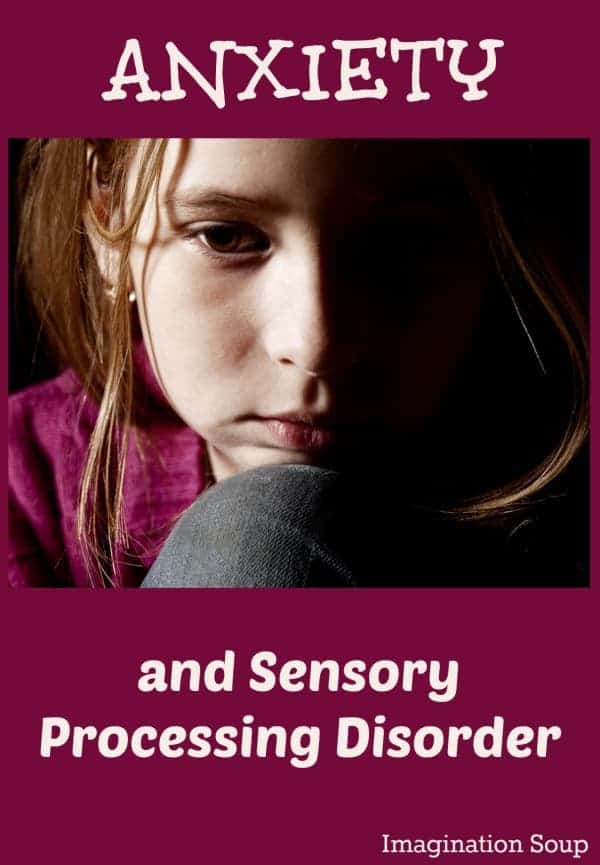
Sensory Processing Disorder
At the time, her anxiety was so overwhelming, she had trouble leaving the house. She’d curl up in the fetal position and cry. A lot. (It sucked.)
Anxiety, if you ever have experienced it, doesn’t make sense.
After a miserable mountain vacation trapped in our condo, I realized that she needed more help than I could give. Professional help.
So, we went to a therapist. Well, two cognitive therapists. (In retrospect, I would recommend finding a good art or play therapist. That’s another blog post though.)
After seven months or so of weekly therapy sessions and little improvement, the last therapist suggested we get AJ evaluated at Children’s Hospital for SPD.
Fast forward to a diagnosis — SPD with tactile over-responsiveness. In other words, her tactile sensory system was over stimulated all the time. It explained everything – like why she hated to be held as a baby, why she flinched when we hugged her, or why the lining of her socks had to be smooth and thread free. Maybe, it explained the anxiety. We would soon find out.
Occupational Therapy at Children’s
We started occupational therapy at Children’s. Sabrina, the wonderfully kind OT, gave us weekly homework including a brushing technique and joint compressions.
Brushing and compressions worked miracles – which is bizarre because they seemed a bit like voodoo. But the proof was the result . . . after only a few months, she was a different kid.
The biggest immediate result? The anxiety disappeared. (And with it, the curled-up in a fetal position melt-downs.)
Another reward of the therapy? Hugs and the occasional cuddle. Soon, AJ wanted me to lay down with her while she fell asleep. We had some catching up to do! I got to make up for so many years where she didn’t want to be touched.
Update
We didn’t do the therapy forever – at home or at Children’s. For one, it was just too expensive. We stopped when we saw results after about 9 months.
Now, when we see that AJ’s over stimulated or seems “off,” we’ll start brushing again for a few days. Sometimes we give her a full-body, super tight-squeeze bear hug. It immediately calms her down. (I know, it seems weird for a touch-sensitive person but totally works!)
AJ is growing into herself every day, without the interference of her over-stimulated senses. She’s an amazing child with a lot to offer the world. If it weren’t for us discovering SPD, we wouldn’t be where we are today.
 Which is why I’m telling you this. Only very recently are doctors considering SPD a legitimate diagnosis. But whether or not it’s in the DSM or people think it’s a “fad,” it’s a very real condition. And something you get help for.
Further Reading
Sensory Processing Disorder involves one or more of the senses and can be either over-responsive or under-responsive. The opposite of AJ is tactile under-responsive, also called a sensory seeker. These are kids who always are touching you, in your lap, petting others, hugging, seeking to be touched. I know of kids whose affected senses are hearing and vision.
SPD Foundation’s website
“Is it Sensory Processing or ADHD?”, ADDitude Magazine
SPD Blogger Network
I hope this helps you – or someone you know.
Do you have any questions for me? Experiences with this?
UPDATE: How Developing the Brain Helped with Sensory Processing, Anxiety & Food Pickiness For Our Kids
My first post about SPD . . .






My son 9yo wouldn’t allow us to touch his head at all. Quite sensitive all over. We have recently found out about “retained primitive reflexes” (different professions may call this by different names). We found a gentle chiropractic clinic in Sydney that specialises in fixing it (don’t go to any old chiropractor!). Amazing. One 15 min session and we can touch his head! No longer sensitive at all. Worth every cent. Now getting all the other ones fixed. I’ve heard counselling can also do it but in 15 min? I think not! Converted! Now also working on fixing all his food allergies. Yay
Wow, very interesting! Our youngest was the same way with her head too. This was as an infant, I am not kidding! She moved on to squint and sort of blink you away if you tried to get close to her face. Then she moved to head banging and her proprioception was way off! SPD was an accurate DX, but it did not happen until 2 yrs! Then it took forever to find a huge vision issue too! So, I will look into your post as this is very interesting! She STILL gives you her forehead to kiss and protects her face and we told doctors this at the very beginning, the same as why she had horrible movement issues and play skills! At almost 10 years old I am still fighting with school system to help or to get a ” correct path” versus ignoring all! And, her seizure doc is so confused that he is trying to pin on a Behavior versus medical reason to push off on someone else!
Best of luck to your family, sounds like you are on a good path and best wishes for the allergy work as I know what fun that is!
My son was 5 when he was diagnosed with SPD and anxiety/ocd, but he had suffered a while before we got a diagnosis. It was so nice to have a name for it and a plan of care. He is 8 now and getting better. Thank you for sharring it is nice to hear similar experiances.
My son also had/has SPD and ADHD. OT was absolutely, hands down, the best thing. He still isn’t crazy about hugs but he’s outgrown a lot of his sensory issues and anxiety. All of the physical and emotional energy I invested when he was younger was worth it! In retrospect I wish I would’ve worried less about what others thought and not feel I had to justify our routines because it was different than “normal”. Don’t forget to take time for yourself – that’s the other thing I wish I had done differently. Now that he’s doing well it’s time to get myself pulled back together. 😉
so happy to hear it! Yes, I do forget – thanks for the reminder.
Thank you for sharing this!
I have wondered about my son for some time now, even spoke to the doctor about it but was told it was just a little anxiety. It didn’t seem right to me then. Definitely going to pursue getting him tested to see if we can find some answers.
trust your instincts – you know your child best!
My daughter has always seemed to be easily over-stimulated. As an infant, she HATED the “enrichment” toys that had flashing lights, sounds, and movement. She only wanted to sit in my lap and be read to — quietly (no acting out the story with exaggerated emotion like most kids seem to like). She’s a teen now and still has trouble with anxiety issues and feeling overwhelmed by loud noises, crowds, etc. You mentioned your child had tactile issues. Is there also a subtype of this that includes over-stimulation of the other senses (especially sight and sound)?
yes! any of the 5 senses can be over-responsive or under-responsive.
See this article for the subtypes of SPD.
http://www.spdfoundation.net/pdf/Miller_Anzalone.pdf