
Everyday Math Makes Me Want to SCREAM
This post may contain affiliate links.
I don’t normally loathe things. But I loathe Everyday Math for the hell it put my daughter through and the poor math foundation it gave her.
Thank you so much.
You Don’t Know How to Subtract, Mom
My breaking point came one Tuesday evening. My sobbing seven-year old daughter told me I didn’t know how to subtract. To learn, I needed to read the four page Powerpoint presentation on her teacher’s website. (Here’s another teacher’s Power Point.) Four. Pages. ABOUT SUBTRACTION. (But, um, I do know how to subtract, don’t I?)
So, like any normal parent, while opening up the file, I ranted on Facebook.
(Did you know there’s a Facebook support group for people like me? –Parents Against Everyday Math.)
Her subtraction was backwards.
It looked like this:
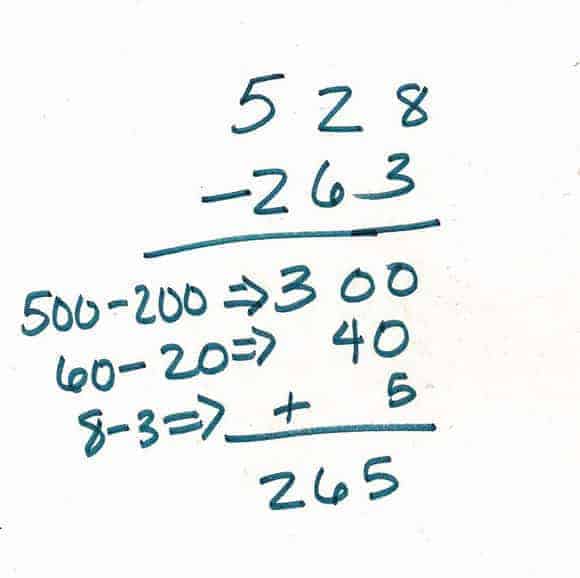
Now, this kind of method is fine for mental math, sure. But NOT for pencil and paper algorithms – it’s confusing and takes too long!
To make matters worse, it’s certainly NOT a good foundation if the math curriculum doesn’t continue like this through middle and high school. A Facebook friend wrote, “After 6 years of homework battles in elementary school, kids get to un-learn [Everyday Math] in middle school with traditional math. How does that make sense to anyone other than the self-appointed Einstein raking it in?”
Everyday Math Leaves Kids Behind
It was bad enough in first grade when AJ didn’t learn money in the one week it was taught, or time in the one week that was taught, or the addition facts when they were taught. She fell farther and farther behind with the promise that the curriculum would spiral back around eventually.
Her teachers through out these years reassured me that, she’d catch on when she was ready and that the research on Everyday Math was extensive, and it was a really a good way to teach math.
[Insert bad word here that starts with BS.]
Because those statements weren’t true. Not good research. Nor did she catch on eventually. (Google EM research and you’ll see, I’m not going to go into it here.)
Since AJ hadn’t learned the basics, she couldn’t catch on to the next spiral months or a year later.
She believed she was stupid.
Conversely, students who excelled in math weren’t challenged at their ability level and were bored. Herein lies a big problem with Everyday Math — it teaches to the middle so you hit the middle kids and leave out the rest.
Blame the Teacher?
An Everyday Math trainer told my friend that it must be because the teachers were incorrectly implementing the curriculum.
Is the curriculum that easy to mess up?
I don’t think so.
. . .
New Math
In a recent phone conversation, Audra Haskins, Director of Lower School at Aspen Academy in Colorado, explained this about Everyday Math, “It doesn’t go deep; there’s not a lot of repetition, review, or application.”
A teacher friend of mine from Twitter added, “The material jumps around so much that mastery is not achieved on any level (at least in second grade.) It doesn’t make sense. I hate it! I am worried about the future of my students because I felt like I didn’t teach solid math this year.”
Investigations is another curriculum in the New Math genre.
Haskins said, “Investigations is designed to assume the kids are good at math and know the skills and apply them. If kids don’t know it, they’re never going to get there.”
Mom of eight and blogger, Gretchen White commented on Facebook, “I LOATHE Investigations. I’ve ranted about it extensively. It’s the main reason we left our former school. I remember our 2nd grader having to count the pockets in our family for homework one night and I realized it was failing him as a mathematician. I’ve been happy with Saxon, although I know there are plenty of Saxon critics. It seems like “real” math, for lack of a better word.”
 Want to read more concerns about Everyday Math? Try Concerned CT Parent, Ed Weekly Blogger, Rational American, Amy Johnson, Andrea Merida, parents on this forum, Rox Dover, and Parent Pundit.
To summarize,
3 Reasons I Hate Everyday Math
- Everyday Math does not teach basic number sense.
- Everyday Math makes simple math operations harder than necessary.
- Everyday Math does not differentiate for kids who need longer time or kids who need to move faster.
Cue Music, Enter . . . Singapore Math
We moved schools to one with a FANTASTIC math curriculum — Singapore Math. It goes deep into twelve concepts and teaches to mastery (meaning that kids learn it before moving to a new concept.) Tomorrow I share my happy experiences with Singapore Math. 🙂
What does your school use for math? Or homeschool? What do you like or dislike about it?








I’m a former classroom teacher who is now a homeschool teacher. We started using Singapore Math with my son in kindergarten. It’s a great program. He’s now in the 2nd grade, and we’ve used it every year. We really love it.
Be sure that you are buying Singapore Math and not a product that covers the concept. ( The Singapore curriculum will have four books for each year.)
i don’t know much about Everyday Math but it is at my son’s school and i totally agree that it doesn’t allow for a child to soar when they have mastered . my son is lightyear’s past where they are teaching him and yet he is forced to stop learning until the curriculum catches up. that’s just wrong on so many levels. when i was teaching in Maryland I taught Singapore Math and LOVED IT. loved that the overall message it sends is the importance of problem solving. it gets kids deeper and gives them many ways to solve problems.
Great post indeed. Thanks to Pinterest, I found you all! I am so glad to see that I am not the only parent that truly HATES EM! That math cirr is SCARY to say the least. And I can relate to all of you.I have 3 children (3rd gr, 1st and PreK) My 3rd grader started with Saxon in Kg and I was not all that thrilled, however, by the end of the year, she was at almost a yr & half ahead & mastered her math facts. I moved them from private school to an awesome charter school with in my opinion, one of the best cirriculums around that taught Singapore Math along with Spalding too. In 2nd grade my DD not only mastered the 2A & 2B concepts, but tested out & moved up to 3A & 3B, along with several other students. She had a very dedicated teacher that encouraged the students that were ahead to even study the Bar Modeling concepts in 2nd grade after school! My son also studied SM in Kg and was doing fantastic! They even loved math! Now the bad part…moved to Michigan where the public schools teach EM! I’ve heard & read about the horror stories of EM and for us, they are real! Leaving Kids Behind is right! Singapore Math is nowhere to be found here! Unfortunately, our school decided to pilot EM…am assuming it is cost effective, but not in any way beneficial to our children! While my daughter has an A, but really what does that mean, when they bounce from concept to concept…teaching in “blips” as I call it…not mastering at all! My son is now behind & struggling in math! And to think I was getting so frustrated when my kids didn’t understand their math HW. I get it now! They are not taught to master concepts, but taught to the test! I’ve gone to the EM site per the teacher and am confused as to why they are teaching math this way…backwards & confusing! I’ve even talked with the principal and got the same story…”circle around again and all the studies & reseach, blah, blah, blah. So what am I to do? Am going to “After School” my kids with Singapore math and keep up the Abacus lessons as well. That combo works for my children. Perhaps I’ll get the guts and homeschool!! Homeschoolers seem to get it right!!! 🙂
I’m so thankful for the internet as well – it helps us sane mamas not think we’re crazy, right? So sorry to hear you’re experiencing the horrors of EM, too – poor kids!!! I wish you strength and influence over the decision makers. Good luck!!
Can’t wait to read your post on Singapore Math. My son (in 1st grade) just started bringing some EM stuff home. I had no idea what it was so at least I am aware now.
Great post- thanks for your honesty! We are homeschoolers and are looking around at math curricula. Our local public schools use EM so I’m glad we made the choice to bring the kiddos home. Singapore Math has been recommended to us, so we may try that next year,
I am on your side. it is difficult to see how it confuses the kids. I understand that they want to have different ways to solve math problems and be creative in learning. But the way the curriculum is set up it is not step by step. It is a mix with all kinds of topics in a semester. Should kid learn one and understand the basics of one concept and then move on to the next?