
Everyday Math Makes Me Want to SCREAM
This post may contain affiliate links.
I don’t normally loathe things. But I loathe Everyday Math for the hell it put my daughter through and the poor math foundation it gave her.
Thank you so much.
You Don’t Know How to Subtract, Mom
My breaking point came one Tuesday evening. My sobbing seven-year old daughter told me I didn’t know how to subtract. To learn, I needed to read the four page Powerpoint presentation on her teacher’s website. (Here’s another teacher’s Power Point.) Four. Pages. ABOUT SUBTRACTION. (But, um, I do know how to subtract, don’t I?)
So, like any normal parent, while opening up the file, I ranted on Facebook.
(Did you know there’s a Facebook support group for people like me? –Parents Against Everyday Math.)
Her subtraction was backwards.
It looked like this:
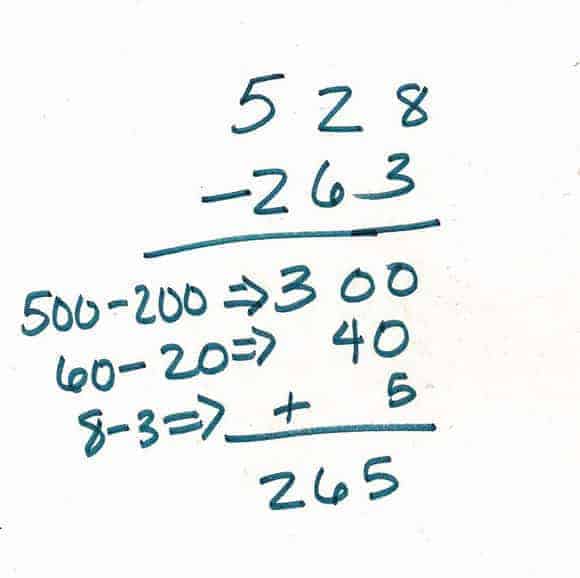
Now, this kind of method is fine for mental math, sure. But NOT for pencil and paper algorithms – it’s confusing and takes too long!
To make matters worse, it’s certainly NOT a good foundation if the math curriculum doesn’t continue like this through middle and high school. A Facebook friend wrote, “After 6 years of homework battles in elementary school, kids get to un-learn [Everyday Math] in middle school with traditional math. How does that make sense to anyone other than the self-appointed Einstein raking it in?”
Everyday Math Leaves Kids Behind
It was bad enough in first grade when AJ didn’t learn money in the one week it was taught, or time in the one week that was taught, or the addition facts when they were taught. She fell farther and farther behind with the promise that the curriculum would spiral back around eventually.
Her teachers through out these years reassured me that, she’d catch on when she was ready and that the research on Everyday Math was extensive, and it was a really a good way to teach math.
[Insert bad word here that starts with BS.]
Because those statements weren’t true. Not good research. Nor did she catch on eventually. (Google EM research and you’ll see, I’m not going to go into it here.)
Since AJ hadn’t learned the basics, she couldn’t catch on to the next spiral months or a year later.
She believed she was stupid.
Conversely, students who excelled in math weren’t challenged at their ability level and were bored. Herein lies a big problem with Everyday Math — it teaches to the middle so you hit the middle kids and leave out the rest.
Blame the Teacher?
An Everyday Math trainer told my friend that it must be because the teachers were incorrectly implementing the curriculum.
Is the curriculum that easy to mess up?
I don’t think so.
. . .
New Math
In a recent phone conversation, Audra Haskins, Director of Lower School at Aspen Academy in Colorado, explained this about Everyday Math, “It doesn’t go deep; there’s not a lot of repetition, review, or application.”
A teacher friend of mine from Twitter added, “The material jumps around so much that mastery is not achieved on any level (at least in second grade.) It doesn’t make sense. I hate it! I am worried about the future of my students because I felt like I didn’t teach solid math this year.”
Investigations is another curriculum in the New Math genre.
Haskins said, “Investigations is designed to assume the kids are good at math and know the skills and apply them. If kids don’t know it, they’re never going to get there.”
Mom of eight and blogger, Gretchen White commented on Facebook, “I LOATHE Investigations. I’ve ranted about it extensively. It’s the main reason we left our former school. I remember our 2nd grader having to count the pockets in our family for homework one night and I realized it was failing him as a mathematician. I’ve been happy with Saxon, although I know there are plenty of Saxon critics. It seems like “real” math, for lack of a better word.”
 Want to read more concerns about Everyday Math? Try Concerned CT Parent, Ed Weekly Blogger, Rational American, Amy Johnson, Andrea Merida, parents on this forum, Rox Dover, and Parent Pundit.
To summarize,
3 Reasons I Hate Everyday Math
- Everyday Math does not teach basic number sense.
- Everyday Math makes simple math operations harder than necessary.
- Everyday Math does not differentiate for kids who need longer time or kids who need to move faster.
Cue Music, Enter . . . Singapore Math
We moved schools to one with a FANTASTIC math curriculum — Singapore Math. It goes deep into twelve concepts and teaches to mastery (meaning that kids learn it before moving to a new concept.) Tomorrow I share my happy experiences with Singapore Math. 🙂
What does your school use for math? Or homeschool? What do you like or dislike about it?








I hear you. We have Everyday Math here in Newton, MA. I don’t like it that much either. I am using Singapore Math at home for supplementation. I just use the TEXTBOOK because it has great intuitive math concept explanations.
It also has enough practice in the textbook without using the workbooks since it’s just to clarify concepts for my kids.
I also like the math apps by Esa Heltulla. His apps follow the Everyday Math curriculum but are very easy to understand. Here’s an example of what I’m talking about for Trade First Subtraction: http://www.pragmaticmom.com/?p=11869 He has about a dozen of so math apps.
The spiraling just doesn’t seem to go deep enough, and there isn’t enough math fact practice in Everyday Math. My mom teacher friends say that it works if you add in supplementation (which they do for their classrooms) but if your teacher isn’t, then you will need to do it yourself at home.
I hope this helps your daughter! I’m sorry that this is such a bad experience for her. My teachers defend Everyday Math with the research on the results.
Pencil and paper math is important for future education and critical thinking skills. The plethora of math choices will make it tough for high school and college educators to have a baseline expectation of students. As a parent I feel obligated to supplement my child’s education where appropriate. If they study traditional math, I should expose them to mental math. If they study everyday math, I should expose them to obscure pencil and paper math (square roots, etc.). Looking back 100 years ago, the pencil and paper math capability of high school graduates was amazing. 100 years from now, pencil and paper math will seem like a slide rule.
I. HATE. EVERYDAY MATH. Hate it. My son’s school switched to it when he was in 1st grade (he’s now in 4th) and it’s been nothing but frustration. He’s doing okay with it – but just okay. I get the concept behind it – to teach the concept of multiplication, division, etc. – but I think Every Day Math does a terrible job of it. My son struggles with every new concept, and I struggle to help him because I have NO IDEA what he’s supposed to be doing, and then – just when it starts to click – they’re on to the next concept. There’s no practice, no drilling it in. So when when concepts DO “spiral back around” he has to relearn them.
A neighboring school switched to Singapore, and I hear nothing but good things from them. Due to a recent redrawing of the school boundary lines by the district, there are a number of families with children attending both schools and ALL report that their Singapore students are far out performing their Every Day math students. Since it’s a district mandate that the schools use Every Day math, in order for us to ‘opt out’ as our neighbor school did, the PTA has to come up with the approx. $20k it would cost to buy books, materials, training, etc. for a new curriculum. I’m happy to say that, even with the price tag, our PTA has elected to aggressively pursue switching.
To blame or not to blame?! Only blame if no one tries to remove the program. If they try, at least you know they tried.
Teachers have the power to have curriculums changed if they united and refuse to use a curriculum. It’s hard to do, but teachers do have the power.
Parents have the power to united and refuse to let their children use the program. It’s hard to do but parents do have the power.
Parents and teachers together have more power!!
And by the way, anyone can teach their kids to add and subtract at home, and let the teachers drive them crazy at school with the weird math program. But at least they’ll know how to do it. Everyday Math, ummm, not really!!
Please don’t blame the teacher! 🙂 We use Investigations in our district and have complained for YEARS! Our parents have complained for YEARS! The solution, buy their handbook that parents can keep at home. We were told if we were “caught” using another curriculum…. Or, if we “supplement” with non-mandated District material… It is sooooo frustrating!
I have heard good things about Singaore Math as well.
Totally agree. Most districts that require a certain text scare their teachers into using it. I’m a math consultant currently working with a district who was used EM for years. They are now starting to let teachers do their own planning rather than following it robotically, but a lot of teachers are scared they’re going to get in trouble. So PLEASE don’t blame the teachers!! This is district level decision that most teachers have no control over.