Author Interview with Middle Grade Graphic Novelist Siblings Kim and Chas!
This post may contain affiliate links.
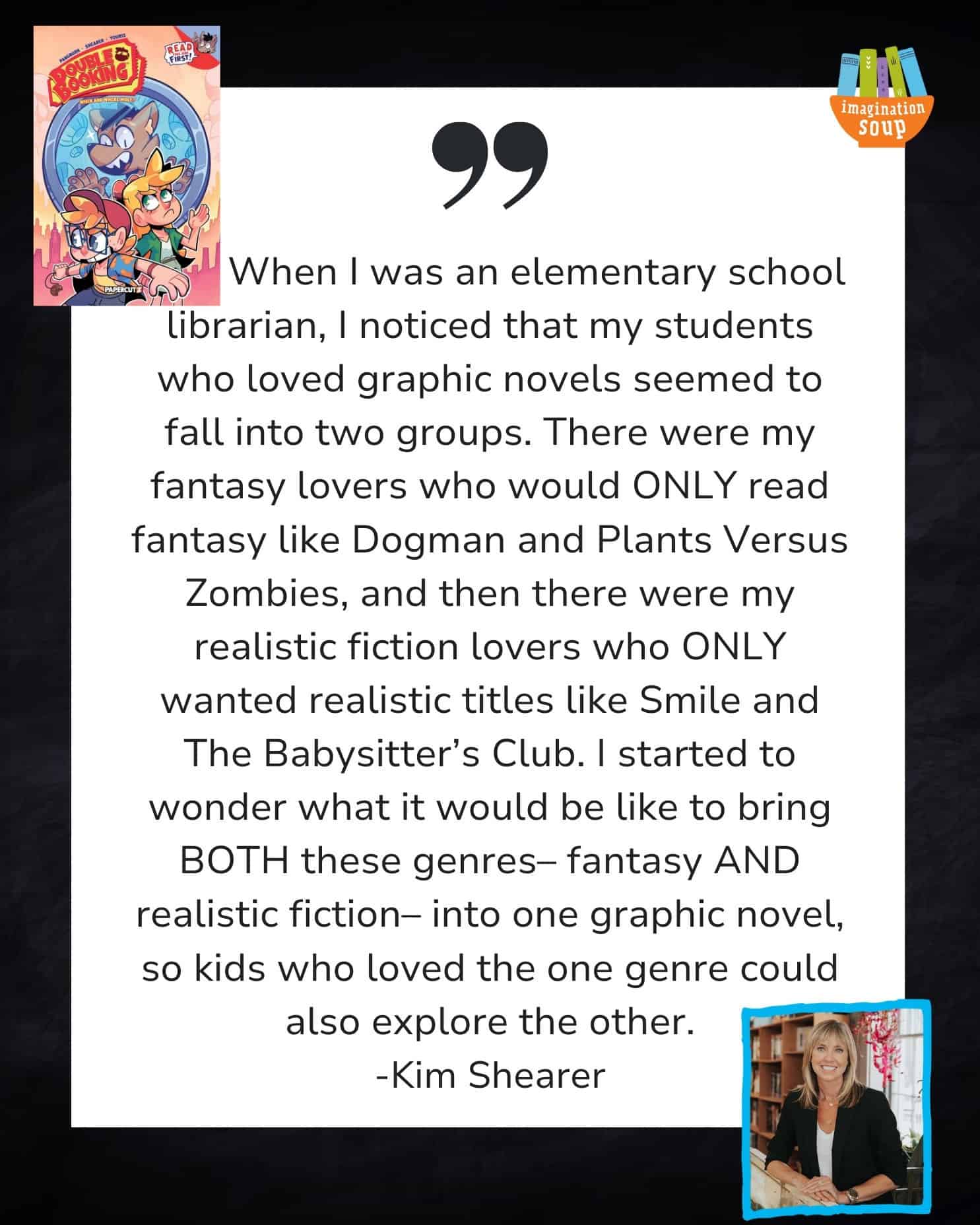
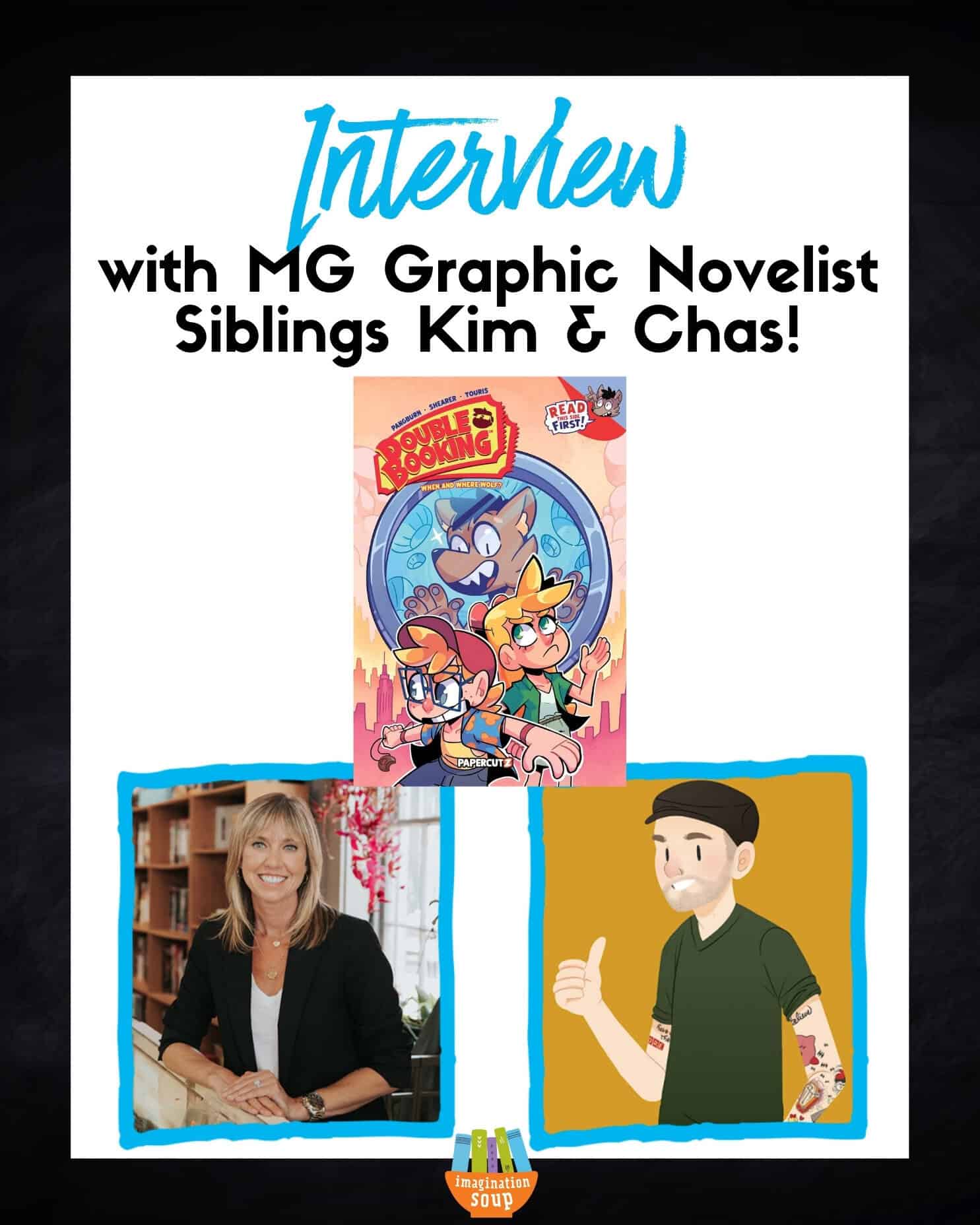
Double Booking is a two-book series (so far) that’s a flip graphic novel, meaning it’s two stories, two perspectives, and two front sides of the book, with each story ending in the middle. When you finish one story, you flip it over to read the other story. Each of the stories is written by real-life siblings Chas! Pangburn and Kim Shearer. The art is created by Nic Touris.
Today, I’m thrilled to interview sister and brother Kim and Chas! to talk about their ideation, collaboration, making graphic novels, and more!

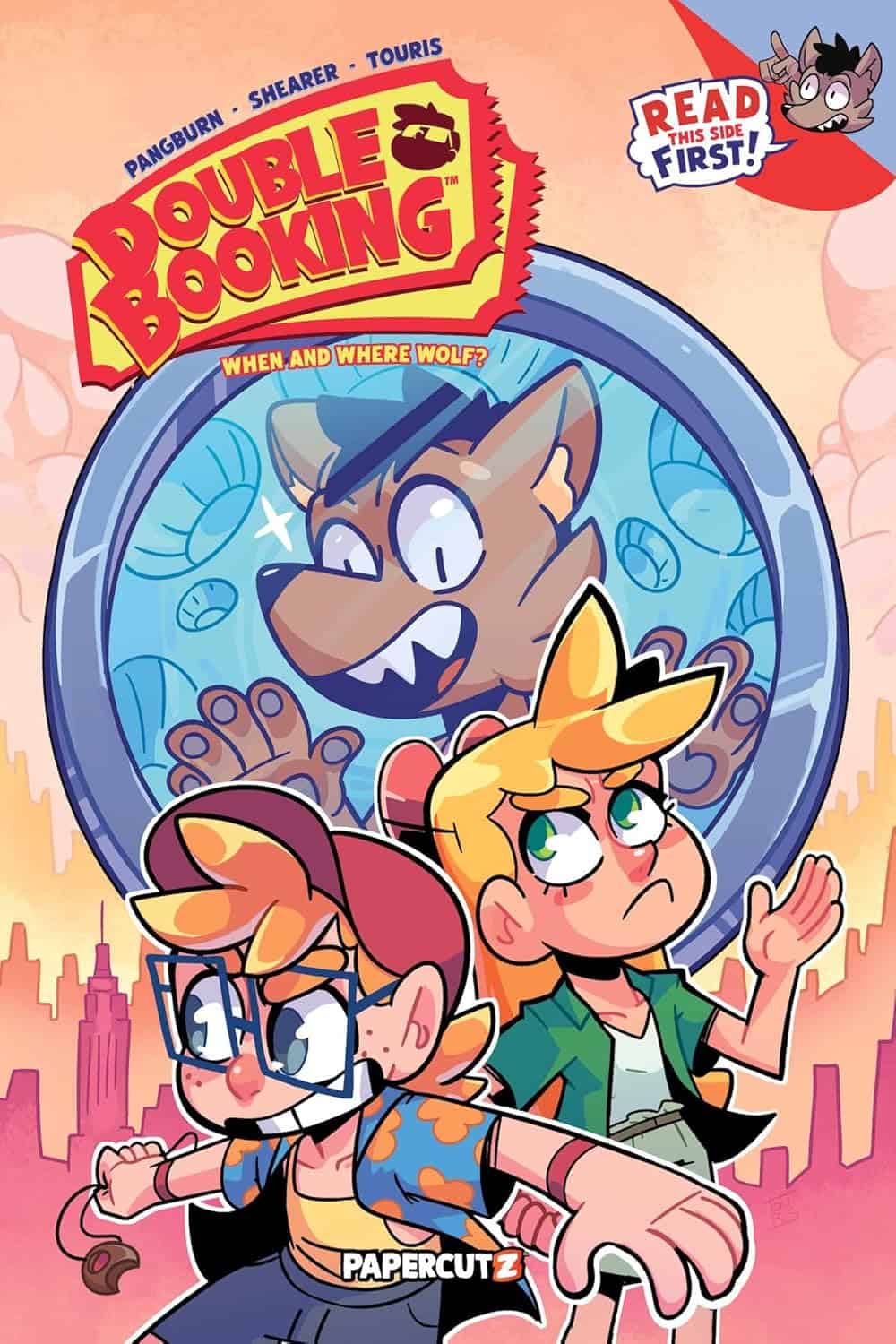
About Double Booking: When and Where Wolf?
TWO interconnecting sibling tales written by actual siblings! The middle-grade graphic novel series continues with more adventure, humor, teachable moments, and bone-chilling fun!
While on a cruise trip with their father, two siblings, Otto and Nan, learn of a furry menace wreaking havoc for passengers: a real-life werewolf! The resulting “weredunit” adventure has them questioning family, fellow travelers, and even themselves as they battle the ocean’s waves and the full moon. Canine capers are nothing to bark at…especially for two growing kids!
READ MY REVIEW HERE! (Hint: I loved it!)
Author Interview with Graphic Novelist Siblings Kim and Chas!
Melissa: I love the themes of growing up, transformation, and family in WHEN AND WHERE WOLF in an action-packed adventure story with werewolves! Did you begin with the theme or the plot?
Kim: The general idea for Double Booking: When and Where Wolf? came to us on a mini road trip to Columbus. It was actually the day Double Booking: The Tail of the Mummy Cat came out, and we were on our way to a signing. In our excitement, we were daydreaming and tossing around ideas for a sequel (oblivious to the fact that we WOULD actually get to write one months later). We talked about Otto and Nan being older, going through changes. Otto being taller. Nan having braces. And when we began discussing the various supernatural creatures we would love to incorporate, werewolves came up. We immediately knew it was the perfect creature to help explore themes of growing up and transformation! Our original idea for Double Booking took place on a cruise ship, so werewolves also allowed us to tie in that setting because of the moon/tide connections. So, that was a fun little bonus, too!
Chas!: Surprisingly, we actually began with the monster!
After playing with mummies in Double Booking: The Tail of the Mummy Cat, we knew we wanted a new creature in a new location. However, from the old Universal flicks to Hammer horror films to modern “elevated horror” stories, every classic monster has been done before and in numerous ways.
For Double Booking 2, we knew that:
– We wanted a new cute creature to frame the book around.
– Ideally, said creature would speak. (Although Princess Tiaa–aka the “Mummy Cat”–is adorable, stories can be a little more engaging when characters can talk!)
– The chosen creature would most likely dictate the story’s themes.
All of the classic universal monsters are so enduring because of their associated thematic storytelling, so we piggyback off of these existing tropes. However, we do our best to add in fun “twists” to make the character more unique, engaging, and fun. E.g., this time around, it turned out to be a vegan werewolf! That tweaked component opens your mind to all sorts of storytelling “What if” options…while also paying respects to the expected thematic beats.
Melissa: Do you brainstorm the story ideas together or separately?
Kim: Both! We brainstorm the general skeleton of both stories together, and then we separate (Chas writes Otto’s side, and I write Nan’s). Within those individual stories, we brainstorm independently, but we always run our new ideas by each other. Then, once both sides are written, we refine and brainstorm together again. Our writing journey really parallels Otto and Nan’s adventures: we’re together, we separate, and then we come together again!
Melissa: Once you have your big idea, how do you create the book? Do you outline first, make thumbnails, write it as a script…give us the details, please! (And how did you make your intentions clear for Nic, the artist?)
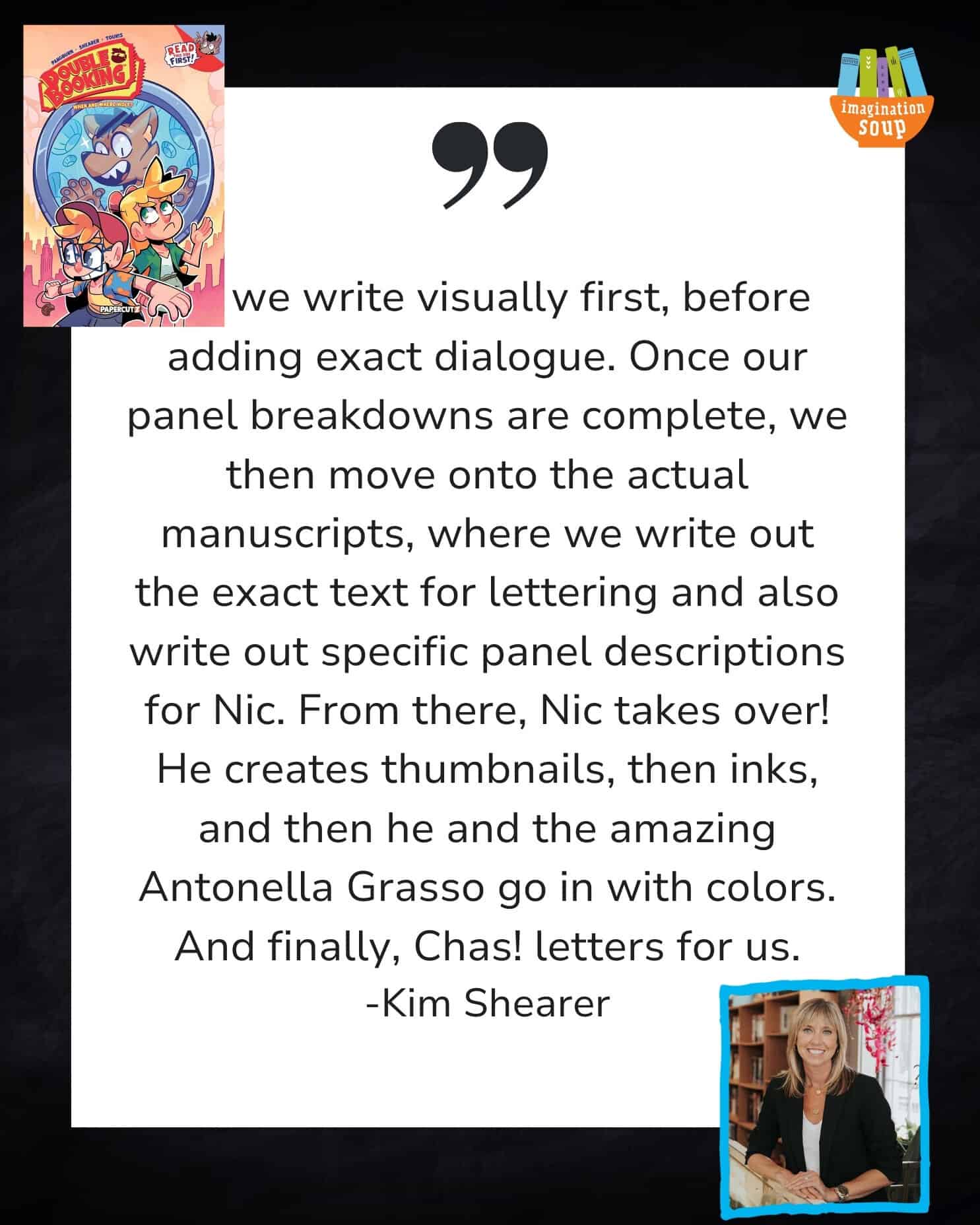
Kim: To start, Chas and I create a general summary together for both sides of the book. Once that receives approval, we split up for the scripting process (Chas tackles Otto, and I tackle Nan). We both start with page breakdowns where we outline how many pages will be devoted to each major scene. After that, we move on to full panel descriptions, where we map out approximately how many panels will be on each page and what’s happening in each panel.
So, we write visually first, before adding exact dialogue. Once our panel breakdowns are complete, we then move onto the actual manuscripts, where we write out the exact text for lettering and also write out specific panel descriptions for Nic. From there, Nic takes over! He creates thumbnails, then inks, and then he and the amazing Antonella Grasso go in with colors. And finally, Chas letters for us.
Nic is incredibly talented, and we trust him so much, so our panel descriptions are really just a jumping off point for his imagination. We actually really love when he goes rogue and adds the unexpected to a page. If there is something that needs to be specific for plot, though, we’ll often just link a sample image to the script so he can see what we are imagining.
Chas!: As with Otto and Nan’s adventures, the collaboration between my older sister and myself involves teamwork, breaking off and doing our own thing, coming back together, and a whole lot of trust.
We typically start off each project with a brainstorming session, where we rattle off every concept we can think of. Lots of “Yes, but what about _____” and “Wouldn’t it be fun if we ____” chats where we intentionally point out why something would/wouldn’t work. No idea is bad and no idea is great–we’re just trying to figure out what makes sense for our characters and what we’d personally enjoy writing. Eventually, we land on something that feels right and snowball the storytelling from there. During this phase, we put together a complete outline for the entire book that we eventually submit to our editor for approval.
After the outline is approved, it becomes the project’s north star–we both know what we’re working towards. Naturally, we then separate to create breakdowns for each half of the book–Kim works on Nan’s side, while I work on Otto’s. Said breakdowns are a half-step to a full script. They’re a great way to preemptively figure out the pacing of a book before diving into a full script. Typically, they just involve the page number, the panel count, and a simple one-sentence write-up for each panel. Maybe some dialogue for flavor/tone, too.
Once the breakdowns are approved by our editor, we then fully dive into the script for each side of the book. With the main beats already locked in, the focus becomes dialogue and fleshing out panel descriptions for the artist.
Through every step of the process, Kim and I share what we’re working on with each other before we send it along to others. Since we already have the outline in place, nothing ever comes as a surprise, but we might have a few nitpicky notes for each other at this stage. The nice thing about Double Booking having two different perspectives is that the series concept lets us lean into two tonally different tales. As long as the continuity isn’t broken, we usually just let each other play!
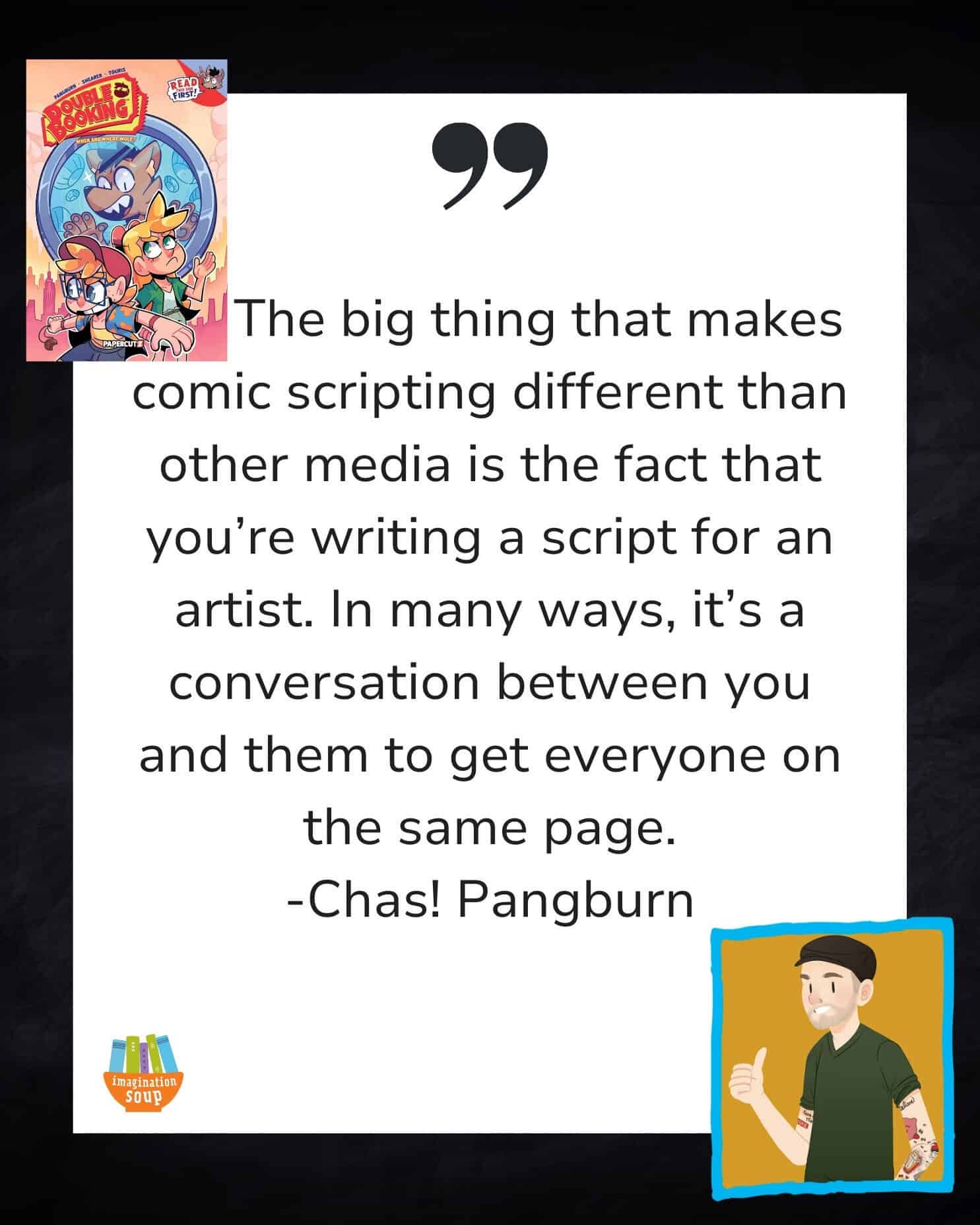
The big thing that makes comic scripting different than other media is the fact that you’re writing a script for an artist. In many ways, it’s a conversation between you and them to get everyone on the same page.
For the Double Booking series, we’re fortunate to work with the talented Nic Touris. Nic is an excellent storyteller in his own right and needs very little direction. Like me, he’s also a fan of memes and internet humor, so we kind of have our own little shorthand going. I can quickly mention something, and he knows exactly what I’m going for. E.g., as an example, here’s a panel description I wrote for him:
– 38.5 means “Page 38, panel 5”
– The underlined blue section is a hyperlink to the following YouTube clip: https://www.youtube.com/watch?v=oabcM9SOF-E

Now, I could’ve just said “Otto, slouched over and defeated, looks sad as he walks down the hallway,” but linking to the above clip from Arrested Development lets Nic know the exact tone/feeling I’m going for and makes things a little more fun for him.
Most importantly, we treat our scripts as structural blueprints and encourage our collaborators to play. Nic is spending the most time with each page, so if he wants to add, tweak, combine, and/or delete panels while thumbnailing, we’re more than okay with it and pivot (if needed) any/all dialogue. At the end of the day, it’s a visual medium and artists aren’t “pencil jockeys”–they’re collaborators and bring their own insights and talents to a project! Projects are always better off if you let a collaborator’s talents shine.
Melissa: The concept of a 2:1 book is genius, and in this second book, you even added a fun search-and-find element. How did you land on this 2:1 idea, and was it hard to convince your publisher of your vision?
Kim: When I was an elementary school librarian, I noticed that my students who loved graphic novels seemed to fall into two groups. There were my fantasy lovers who would ONLY read fantasy like Dogman and Plants Versus Zombies, and then there were my realistic fiction lovers who ONLY wanted realistic titles like Smile and The Babysitter’s Club. All great reads! But they’d really hesitate when I would suggest checking out a different genre. We like what we like, right?
I started to wonder what it would be like to bring BOTH these genres– fantasy AND realistic fiction– into one graphic novel, so kids who loved the one genre could also explore the other. I had the idea of a brother and sister who go on adventures, but only one of them can actually SEE the supernatural elements they encounter.
I told Chas my idea one night over pizza, and he suggested the flip book format. And Nic developed the two different art styles to capture the difference in the siblings’ perspectives. We were very lucky in that Papercutz was excited about the idea from the very start!
Chas!: On my end, I’ve always been a fan of double-sided “flip” comics. While publishers have explored the format here and there in the past, readers typically only see them during events like Free Comic Book Day. E.g., a publisher might release a two-in-one twenty-page comic with each side focusing on a different intellectual property. The stories aren’t tied together in any way, though.
…but why not play with that format and make things tied together?
When Kim mentioned her idea for a story, I saw it as a perfect way to lean into this “flip” format and focus on two different perspectives of the same story. It makes the book more interactive and encourages readers to read, re-read, and notice the differences/overlaps. Thankfully, the crew at Papercutz “got” exactly what we were going for and considered it to be a marketing highlight.
Melissa: What has the response been from readers?
Kim: It’s been so exciting to see how engaged young readers are when they pick up the book. I spent 16 years as a high school English teacher, and engaging students was always half the battle. So, to have parents and teachers approach us at signings to say their elementary or middle school-aged student sat down and read the entire book in one night–that’s just magical! It’s also been a lot of fun for me, as a high school librarian, to have my teenage students stop by the circulation desk just to tell me they loved Double Booking! The response, across all age groups, has been incredible!
Chas!: The response has been incredible–readers of all ages are loving the mix of humor, adventure, and heart. However, there’s nothing more heartwarming than when a friend/family member sends along a photo of their kiddo gleefully flipping through pages. It’s genuinely hard to fight back the tears in those moments.
This hasn’t been widely publicized yet, but volume 1 actually sold out and had to go to a second printing! To me, that tells me that we’re hopefully doing something right. Haha, as long as readers are around, we’ll keep telling more tales!
Melissa: Can you talk more about the collaborative writing process? What was it like, and what advice do you have for others (of any age) who are writing with a partner?
Kim: Something we hear a lot at signings is, “I could NEVER work with my sibling.” People always ask, hoping for some serious brother/sister drama, but truly, we’ve gotten through two books unscathed so far! Every once in a while, we might disagree on something, but overall, I think we balance each other out pretty well. In true first-born fashion, I’m very type A and a perfectionist, while Chas is much more laid back and go-with-the-flow. I often bring my educator/librarian perspective to the table, whereas Chas, a comics editor, brings a more technical/industry perspective. My advice to anyone writing with a partner is to be willing to compromise. Some of our best ideas have come from one of us (kindly) disagreeing with the other’s creative choice, offering a different solution, and then coming up with a compromise together!
Chas!: Honestly, Kim’s response said it best! It’s all about trust, collaboration, and keeping an open mind.
Comics are a collaborative medium where everyone brings along their expertise. The project is king, and there’s no place for egos–everyone’s goal should be to create the best story possible. However, always be friendly and understanding! Comics are fun, so the creation of them should be no different.
Melissa: What is your best advice for kid writers and artists who want to create their own stories?
Kim: Don’t wait! Start putting those ideas down on paper now! I’ve been a comics fan since I was a little girl, and I’ve always had ideas for my own comics– I just didn’t think I had what it took to actually have those ideas published. I’m 45 years old now, and I wish I had put myself out there sooner. Think of the stories I could have been telling all these years! Believe in yourself– and your stories! And start sharing them with the people around you now!
Chas!: Never stop learning!
Read comics, watch movies, listen to music, and experience life. You’ll never know when or where inspiration can strike. “What if” thoughts spring up in the most unlikely of places and can inspire countless tales from there.
If you make something you’re not happy with, that’s okay, but figure out why you’re unhappy with it. You can use that knowledge when creating future stories! If something really speaks to you, figure out why.
You’re a storyteller, so you need to point a mirror at the world and question everything! =)
About Chas! Pangburn, the Brother
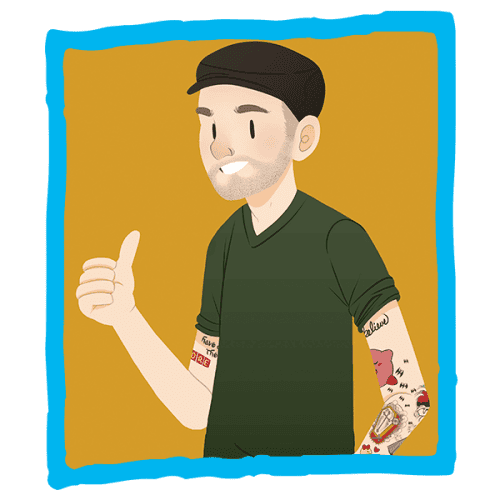
Be it as a writer, editor, and/or letterer, Chas! Pangburn puts words in balloons. He’s been fortunate to collaborate with various creators for publishers such as Dark Horse, IDW, Image, and Mad Cave Studios. Every moment of his free time revolves around video games and spooky things.
About Kim Shearer, the Sister
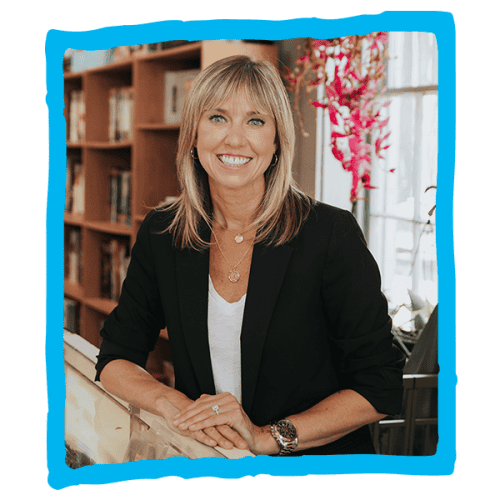
Kim Shearer has been a public educator since 2003, serving students as an English teacher and librarian. She was named the 2012 Kentucky Teacher of the Year. She resides in Kentucky with her husband, her two daughters, and her two rescue dogs, Elmer and Gordie.

Geniales!!!