Author Interview with Jeanne Birdsall
This post may contain affiliate links.
Anyone else a HUGE fan of The Penderwicks series, the series about a family with four sisters, two rabbits, and a very interesting boy?
The author of The Penderwicks series is Jeanne Birdsall, and she has A NEW BOOK. She talks with me today about her newest middle grade book, The Library of Unruly Treasures. You’re going to want to hear what she has to say…and read the book!
About Jeanne Birdsall

Jeanne Birdsall grew up in the suburbs west of Philadelphia, where she spent most of her time reading and daydreaming.
She decided to become a writer when she was ten years old (1962 diary entry: I think I have the knack), but went off track until she was in her forties. Twenty-five years later, she’s still at it.
About The Library of Unruly Treasures
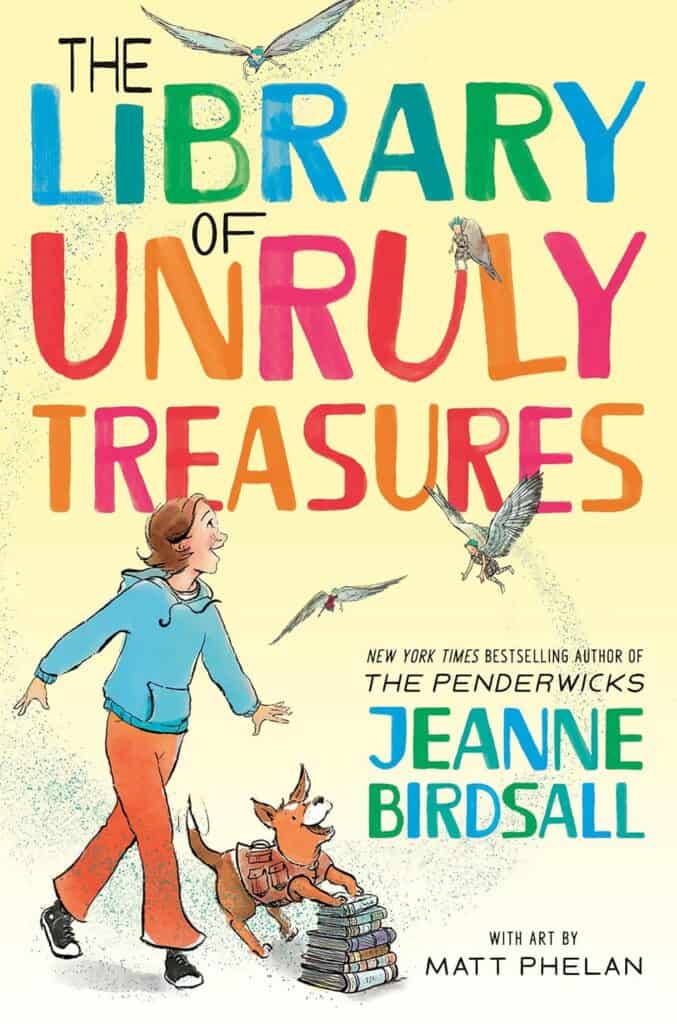
Gwen MacKinnon’s horribly selfish parents aren’t much interested in taking care of her. So she’s not at all upset when she’s foisted onto her never-before-seen Uncle Matthew for two weeks. Especially when it turns out he has a very opinionated dog named Pumpkin.
Things take a turn for the weird when Gwen makes a discovery in the local library. A discovery that involves tiny creatures with wings. And no, they’re not birds, or fairies (do not call them fairies). They’re Lahdukan, an ancient and learned species. But why can only Gwen and the youngest children, gathered for story time, see them?
The Lahdukan insist that Gwen is destined to help them find a new home. But how can a girl as unwanted, uncourageous, and generally unheroic as Gwen possibly come to the rescue? Pumpkin has a few ideas…
Interview with Jeanne Birdsall
Melissa: How did you learn about the Lahdukan and their culture? Did you meet a scholar when you were a child?
Jeanne: The first Lahduka came to me one night when I was falling asleep, stealthily peeking into my consciousness. After that, I wanted to know everything about him and the Lahdukan. I studied strange and ancient texts, reading between the lines, searching for what wasn’t written down. In other words, where a secretive clan of small, winged creatures might have hidden themselves throughout history. I also happened to run into a human girl at the Isabella Stewart Gardner Museum in Boston who was willing to tell me more. She was quite helpful.
I don’t remember any scholars from my childhood, but my husband and our son are both scholars. They aren’t as ditzy as the Lahdukan scholars, but at least I had a frame of reference.
Melissa: Let’s say, hypothetically, you invented a fantasy creature, language, and culture for a totally different book that is not at all related to this book about a totally real group of smallish folks with wings. What would that process be like?
Jeanne: I expect I’d think about what kind of creature I’d like to meet, and have them be from a place I love, like Scotland, for example. And then I’d think of what it would be like to meet them back when I was a young girl, and make them fun to meet, not scary, and a little confusing, too. I’d wonder what kind of history would have made them who they are, and go way back in time, to before humans were writing anything down, and dream up how my creatures would have lived back then. Making up the language would be the easiest. I could have them say anything at all, and who would know? It would be my language.
Melissa: What do you hope readers take away from this story?
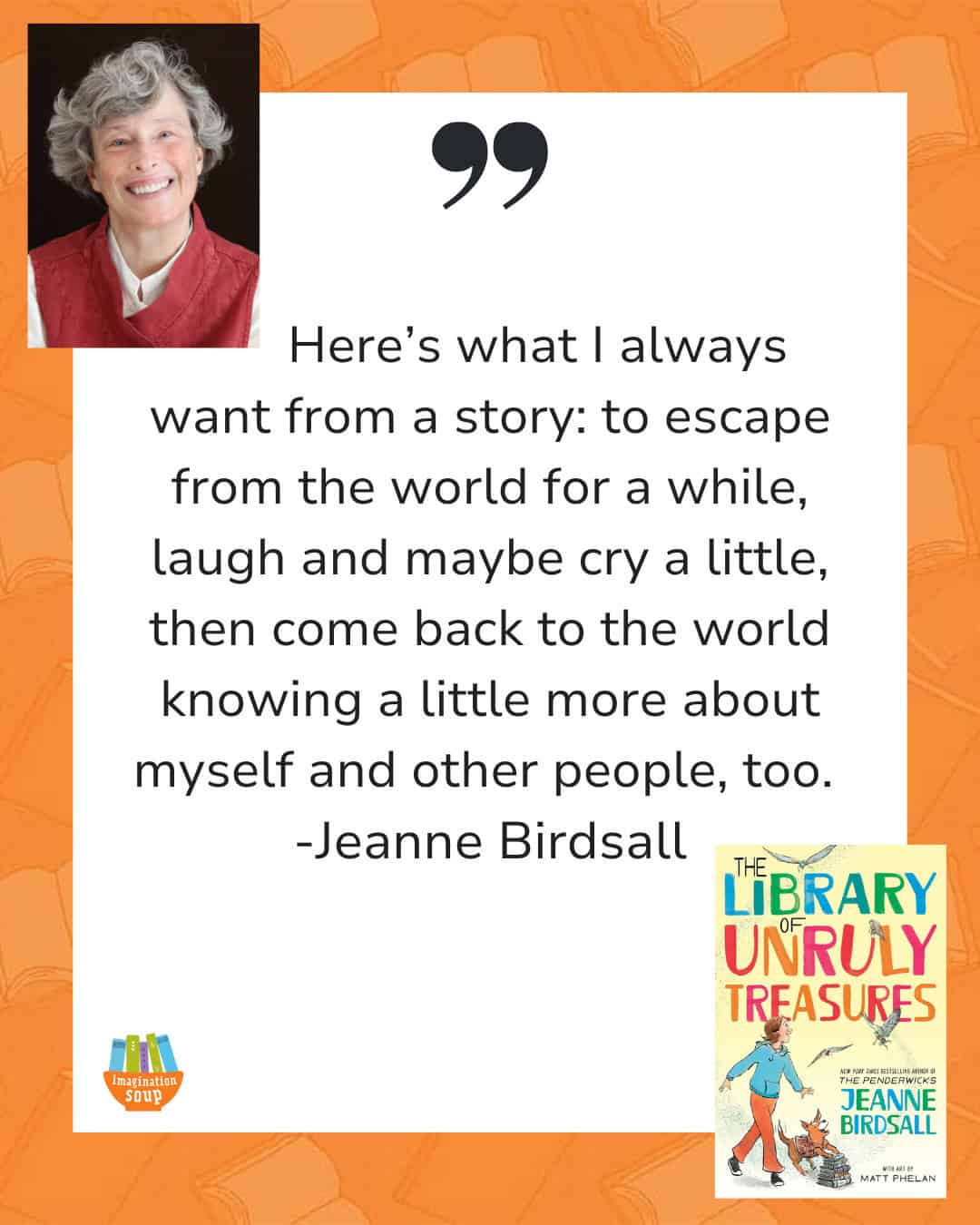
Jeanne: Here’s what I always want from a story: to escape from the world for a while, laugh and maybe cry a little, then come back to the world knowing a little more about myself and other people, too.
Melissa: This feels like a classic family read-aloud for families with children of different ages. Do you have a recommendation for what ages of children will enjoy it and any fun activities they could do while reading/listening?
Jeanne: While I write specifically for what I’d have liked when I was 8 to 12, I think that littler kids would enjoy having it read to them, too, even if they don’t get my references to Doctor Who. And I’m hoping the older siblings and grown-ups reading it to the smaller ones also like it, even if they’ve never seen Doctor Who. Speaking of listening, the audiobook for Library of Unruly Treasures is a special treat. The narrator, Sorcha Groundsell, grew up in the Hebrides Islands west of Scotland, near where the Lahdukan lived a few thousand years ago. Her voice is beautiful, lilting, and exactly what you’d want for a story about small, mysterious creatures.

Melissa: Talk a bit about the process of leaving behind a beloved series and writing a story in a completely new world with new characters. Was this a long process where you built the world before you started writing, or did it just come to you as you wrote?
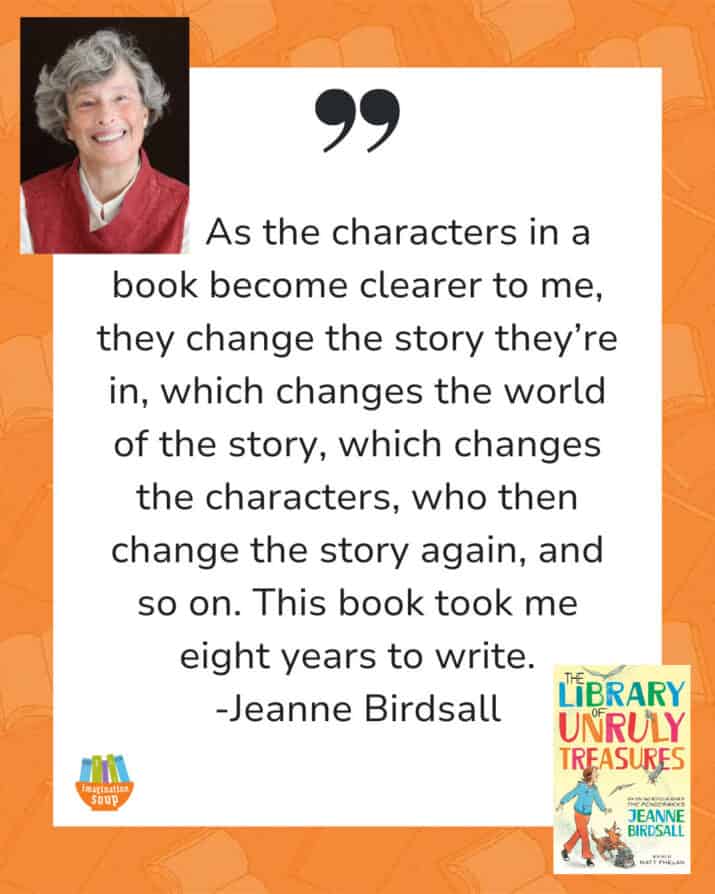
Jeanne: I spent twenty years with the Penderwicks. Pulling away from them was like becoming a new author all over again. World-building is organic to the story for me—this was as true for the realistic world of the Penderwicks as for the almost realistic world of The Library of Unruly Treasures. As the characters in a book become clearer to me, they change the story they’re in, which changes the world of the story, which changes the characters, who then change the story again, and so on. This book took me eight years to write.
Melissa: You always have kids of different ages in your stories. Is that intentional, and if so, why?
Jeanne: That’s an interesting question. I’ve never thought about it. Maybe it’s because someone who’s five is going to experience an adventure differently from someone who’s eleven, and that tension between the experiences is part of what drives the story. Also, throwing in a little kid always makes good opportunities for laughter.
Melissa: I love the Lahdukan rituals. Was it important for you to include rituals in their culture, and if so, why?
Jeanne: Their rituals are an important part of their lives. Not talking about them would be like writing about a dancer without mentioning dance. Plus, the rituals were a delight for me to write about, with the chanting, fragrant spices, and embarrassment of holding other people’s faces.
Melissa: What is your best advice for grown-ups who are trying to encourage children to read more?
Jeanne: That’s an easy one. Simply read. A houseful of readers makes new readers.
Melissa: What is your best advice for children who want to become better writers?
Jeanne: Another easy one. READ, READ, READ! Figure out what you like to read, and read lots of it. When an adult tells you to read a book you don’t like, figure out what’s wrong with it, and promise yourself you won’t make the same mistakes in the books you write.