
Problems with Reading, When To Worry
This post may contain affiliate links.
Sometimes our children experience problems with reading because there is a bigger learning or vision issue. Here are the red flags and signs to watch for to decide if you need further evaluation, and a bit about my own story.
Denial Doesn’t Work (Darn It!)
When JJ had her first seizure at age 3, the neurologist told us it was most likely a one-time thing. That’s exactly what I wanted to hear so I believed it to be true. Yeah.
When she had her second seizure, another 40 minute doozy, the neurologist told us she could be brain damaged if we didn’t catch them and stop them. I decided not think about it.
Eventually, I had to face reality and a diagnosis of –gasp — a LABEL!: epilepsy. Plus medication and constant vigilance.
As it turns out, denial doesn’t make anything go away.
(You already knew this though, right?)
Acceptance of reality got JJ the help (diagnosis and medicine) she needed.
Signs of Reading Problems
I share this because I need you to hear me on this.We must not pressure our kids to read, but we also must recognize when there are signs of a problem.
The harsh reality is that denying the truth that your child may have a learning issue, won’t help your child — the sooner you get answers and help, the better for your child. Denial doesn’t make it go away. Sorry. I’ve tried it. Doesn’t work. (You’re welcome. That’ll save you $$ for therapy.)
I’m writing this post because there are some of you who are still in denial.
I’ve taught your kids. You are my friends. And I’m worried about your kids.
Here’s what I can tell you . . .

Learning Disability (LD) Red Flags
According to the Reading Rockets, signs of LD are:
• spelling the same word differently in a single document
• reluctant reading or writing
• trouble answering open-ended questions
• weak memory skills
• slow work pace
• frequent misreading of information
• easily confused by instructions
• poor organizational skills
If you’re noticing, or your child’s teacher notices, that information isn’t “sticking” as in the case with some of the above red flags, it’s absolutely worth it to get more information. And by more information, I mean testing. Especially if your child is behind in school.
Most of us, me included, like to keep on our rose-colored glasses as long as possible. But, you know as well as I learned that head-in-the-sand thinking won’t help our kids.
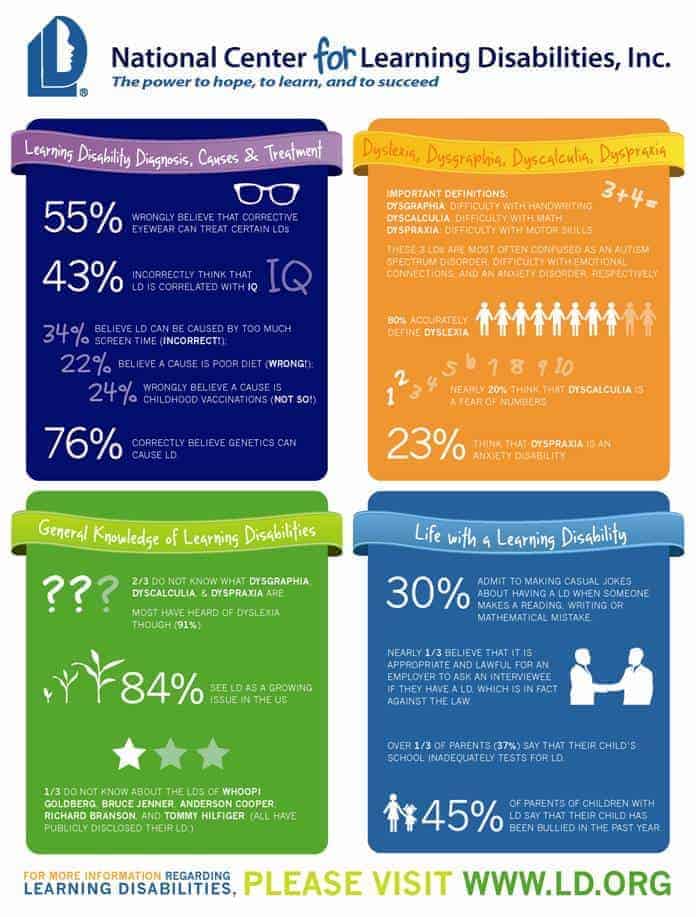
Here’s some interesting statistics about how uninformed we are about LD (learning disabilities) in general.
Vision Red Flags
One year, I had a fifth grader that worried me more each day. He seemed spacey, like he wasn’t all there. He didn’t seem to understand what was going on at all despite doing fine academically in previous years. Finally, I had a meeting with his parents and the Special Ed team expressing my concerns of a serious learning problem. I was really worried! His dad asked, “Do you think I should make him wear his glasses?” I could have wrung the guy’s neck.!!! How many weeks did this child spend in my classroom totally unable to see? It was an easy fix — all he needed were his glasses.
If you’re wondering if your child has a vision issue, here are some red flags:
• squinting
• eye rubbing
• burning, itching, watery eyes
• headaches
• trouble reading words he already knows
• losing place while reading
• saying that the words look blurry
• bumping into things
Get this: vision screenings will NOT catch vision issues that interfere with learning such as tracking left to right. You need a comprehensive vision exam.
Next Steps
For vision, you will need to go to your own optometrist. However, for learning issues, you are legally entitled to request an evaluation of your child under the Individuals with Disabilities Education Act (IDEA) from your school. However, that doesn’t always mean the school will comply with your request. I’ve heard lots of stories about parents who have to fight for evaluations, or get their own independent assessments done. (Expensive!!) Ask your pediatrician as they should be able to help with assessment recommendations.
You can learn more about IDEA and the evaluation process at the National Center for Learning Disabilities. For information on your legal rights, go to Wrights Law.
Are you seeing these red flags?
If you’re a parent who has experienced this, will you comment and share your story? It always helps others to know someone has gone through this before them.
We learn from each other. We can support each other through this.
 glasses photo Some rights reserved by derekGavey
see also:
Learning to Read: Word Attack Strategies Beyond “Sound It Out”
Pressured to Read: What to Do If Your Child is “Behind”






heck, i’m a elementary school teacher with dyscalculia, a processing problem, and short term memory problems. i also am borderline autistic with very mild PDD. look how far i made it! I wasn’t diagnosed until i was out of high school (which i struggled with but pulled thought) and i went to college and now i’m a teacher, teaching students, with LD’s! they encourage me each day to become better for them. an LD doesn’t make you any different than the next person!
And ADHD! i forgot about the ADHD part of my LD’s. i cna’t stay organized for my life, but when it comes to planning for the kids at school, everything is detailed to the letter. my bedroom? a mess! the kitchen? a disaster!
I apologize if this is long. I have a 7yr old daughter who is in 1st grade(her birthday falls just after the Sept. 1st deadline). She has had a history of medical problems from birth and she had open heart surgery at 4 1/2. She was always very smart and her memory was just incredible when it came to musicals. She can memorize songs and dances after just seeing them 1 or 2 times, but she didn’t really start talking where we could understand her until she was about 3 1/2, though she had her own language and could sing the melody. Sooner Start here worked with her from the time we were able to bring her home until she was 3 and she was able to enter the DD Pre-K program at a school nearby. She went on to regular Pre-K but was unable to sit. The doctor diagnosed her with ADHD and started her on Ritalin. We started out with just once in the morning, since she only went half a day, then increased to twice.(once in the morning, and again at noon). Once she started this, she was reading full sentences at the age of 5 while in Pre-K.
She went on to Kindergarten and was doing okay with her sight words. She has always written some letters and numbers backwards and continues to do so. We are told this is normal. We have a stack of sight words from Kindergarten that we have been doing for over a year now, nothing has changed, only something did over the summer. She started struggling more and more. By the time she started 1st grade, she now literally shakes when it comes to those words and acts like she is learning to read all over again. She is unable to say them, she has to sound them out as though she doesn’t know them at all. When she brings home her reader from school to do her reading assignment, she physically starts shaking and crying when I ask her to read to me. I try to make it fun and often times we take turns reading. I read the paragraph so she hears me read it, then I have her read it back to me. Same thing with the sight words. We play games with the words as well so it doesn’t seem like work, yet she still has to sound them out. Her ADHD goes beyond just not being able to sit still. She is unable to organize anything. Cleaning her room is impossible unless someone sits in there with her and physically helps her. We use buckets to organize different items as well. She has way too many issues with her ADHD to list them all here, but they affect her school work as well as her everyday life. Her doctor has referred her to a Developmental Pediatric Specialist, but it will take them so long to gather all the information from all her doctors that she has seen in her life, they won’t even see her until February or March next year. Her school Psych agreed to test her finally to see if she qualified for more help there as well, but even that takes time.
Our biggest issue this year has been her teacher. I can’t tell you how stressed our daughter has been. Her doctor changed her medication to Concerta. We have had to increase her dosage and she is now at 27mg. There are days when it seems like she never took anything at all. This part breaks my heart. She is in a class with a teacher who yells at her students. My daughters hair has started falling out the last two months and she now bites her nails so bad, her fingers often bleed. She has had mouth sores 3 times since school has started and her doctor and the dentist have both told us they are from stress and that only time will heal them. We have had several meetings with the Principal. It took me getting really upset before her Teacher would finally meet with me. We have requested she be moved to another class but I am being made to feel like I am wrong and a bad person for having done so. I find myself sitting and crying over all of this when I am alone because I feel like I am screaming inside and no one hears me. My daughter needs help, I know it’s out there, yet it seems like it’s so far away.. yet other times, it seems no one cares. I sat down with her reading teacher yesterday as she explained to me that in January she will be tested. At that time she will be expected to read 25-30 words in 1 minute. My heart sunk, help will not come soon enough. What am I to do?
wow, my heart is breaking for you both. First, I must tell you that you are doing the right thing by requesting a teacher who loves your child. Don’t second guess that — you must get her out of a toxic classroom – even if you homeschool for the rest of the year.
I would see if you can get an advocate to help you – lawyers that specialize or someone they can recommend. You need to speed up this process and some systems will drag it out and you can’t wait that long.
I would start calling your pediatric specialist daily to find out if you can get cancellations. Or get in at a Children’s Hospital. Start asking all your friends for recommendations – who they have used, who they suggest.
Also, I’d back off as much as you can, cleaning her room, that sort of thing. Focus on helping her emotionally and mentally because without that being strong, she won’t be learning much anyway. Help her feel safe and confident. Give her little tasks that she can do that will help her feel confident – not necessarily school tasks either. You know what she can do. Putting the forks away. Whatever it is.
Having a child with special needs (don’t you hate that term?) is hard and most people won’t understand. Find people who do – support groups or online. You need to know that you’ll get through this and so will she.
Sending you a virtual hug of support!!!
Melissa
personally, i say get her off of Concerta ASAP! i, and several of my friends, were on it and as i got older, i became more and more depressed. the doctor said that the concerta and the hormones of getting older affected that. it was bad to the point at once that i tried to end my life. same with 2 of my friends. please, i beg you, take your daughter off of Concerta now!
I have taught kindergarten for 13 years and tutor students struggling with ADHD and autisim. At no point is it OK for your daughter’s teacher to make you feel like your feeling are insignificant. I strongly believe that teaching is a group effort and looking at the family and nuturing that relationship is vital to each child’s success. You are the only advocate for your child and if you feel like your child is being mistreated and is effecting her well being you must do everything within your power. I wish she could be in my class!! I would give her a big hug and let her know that she is perfect!
Sorry to read your story. I know what you’re going through. When you complain the teacher hates you and everyone at school does the same. They don’t know what it’s like to live with a child with differences. How about you make flashcards of sight words or buy them in Amazon for special kids. They come with drawings of the actions. It’s called snapwords list a pocket chart cards. Then make a song for the words that belong to the first group and make a hole to the cards on a corner to flip them using book rings. Every new year you have to give a small gift to the teacher. I do it on Christmas. I buy a perfume of 35 dollars or so. Then, you can also buy teachers pay teachers reading comprehension books by Anne Gardner. She has patterned sentences to target every sight word up to level D. Buy scholastic sight words books in Amazon. They also target one sight word at a time and have your child read with you or make a song about each book. They have 8 pages only. I did that with my girl. Still struggling but these things can help you too. They did helped my child. I’m a Prek teacher. You have to create materials for your child to improve and reward her for her efforts that might seem small steps but they push themselves so hard and I recommend praying too. God also can help us with our children get better.?
I’ve been confused by my daughters work for some years now. I started looking into ADD because she does seem to wonder. However her teachers report did not show this. I started to read more on dyslexia, watched the HBO special and pulled all of my daughters school work that was consistantly inconsistant. I wondered how come she could read and get big words but stumbled on words like a, the and and often transposing them. She does well on spelling tests so I kept dismissing dyslexia as a possibilty until I started putting together more information and noting all of the things I have questioned for so long: directional issues right and left, skipping to the next line while reading, trouble with written work and using correct space, using wrong operation while doing math facts. Reading a word fine on one page then get the same word wrong the very next page. This last one was a big one for us, often frustrating and now it all makes sense. I am getting her tested through the school, I am fortunate that the school has already taken steps in helping her taking her out of class for math and reading, I feel like she will now have a program that can be designed for her learning style. It’s also important to note that she has remarkable memory skills which is why kids often get over looked because they can compensate for their weaknesses. I would never want to put a label on my child that would carry them through life, but if there are interventions that can help her, for her to know she is not alone; but instead among a group of wonderful leaders, artists and business owners I am glad to give her whatever if it means she can benefit.
There needs to be a different name for a LD. My dyslexic son is definitely not disabled. He is extremely smart and way beyond his grade level in many ways, just not in reading and handwriting. Give him a box of Legos (no instructions please) and he can build the most amazing things. We taught him dyslexia does not mean he is stupid. It means his brain works faster than everyone else and we have to teach it to slow down so he can put the letters together to form words.
I went to a college for LD students. they refused to call them learning disabilities. instead they called them learning differences! no one is disabled! everyone learns, some just learn different!
I haven’t thought about getting my child’s vision checked because she is very young, but I will definitely be looking into this. Thanks!