Helpful Ways to Teach Kids Metacognition
This post may contain affiliate links.
Teaching children to think about their thinking, to use metacognition, is essential to their learning. This is because when children can use metacognitive strategies to understand their strengths and weaknesses in learning, or how they learn best, it’s hugely impactful on their success not just academically but in life, too.
Confucius said, “A man who has committed a mistake and doesn’t correct it is committing another mistake.”
Or, as Dr. Phil asks his guests, “How’s that working for you?”
When learners become conscious of their thinking, they can become aware of their strengths and the strategies that are useful (or aren’t useful) to their own learning in order to either replicate their learning processes or to change up their method and process to better fit the way they learn best.
What is the metacognition definition?
The definition of metacognition is thinking about one’s thinking. More specifically, being metacognitive helps kids understand their own learning process.
Metacognition with Kids
So how can you use metacognition with children?
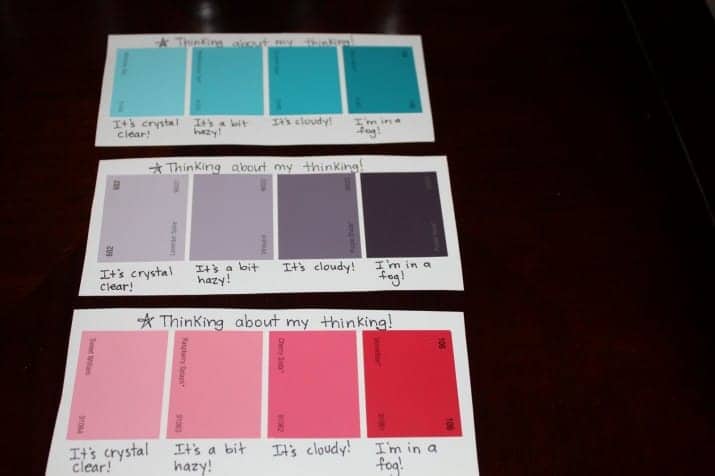
Last week, I watched my nine-year-old daughter AJ studying for her spelling test. Her dad asked her the words and she spelled them — incorrectly. Over and over — wrong, wrong, wrong, again.
I’d finally interrupted and asked if we could stop. I asked what strategy she was using to spell the words.
“I don’t know.”
“Well, I see that you’re rolling around the floor and it seems like you’re randomly guessing the words, do you think guessing is your strategy?”
“I don’t know.”
(The goal here is for AJ to know what strategy she is using AND to know if the strategy is working or needs to be reconsidered.)
“Did you know that good spellers see the word in their mind like it’s written on a chalkboard? That’s called visualizing. Before you answer daddy’s question the next time, I want you pause and not answer right away. Try to picture the word in your mind and then spell what you see.
Let me show you how I do it. I’m trying to think of spelling the word heart.” [I close my eyes.] “Okay, I see it. h – e – a – r – t. Heart.”
Sensory Interruption: Unfortunately, AJ didn’t change her strategy and got very frustrated. Watching her behavior, I realized that I needed to do some OT to calm her down. I brushed her and gave her a tight bear hug for about ten minutes. This is how it goes for a child with Sensory Processing Disorder (SPD) — and when her senses calmed down, we could try again.
But, you get the point, right? We need to help children label their thinking strategies or problem solving and then discuss specific strategies that are working or that the student could try instead.
Like creativity, metacognition is not an add-on to a learning activity but is embedded during the learning experience.
If we can help our children think about their specific strategies, we can help them become more skilled learners.
Metacognition Awareness
John Flavell, a researcher of metacognition, believes kids need awareness in three areas:
1. An awareness of knowledge: understanding what they know
surveying
questioning
reading
reciting
reviewing
–SQ3R (Robinson)
2. An awareness of thinking: understanding cognitive tasks
selecting strategies for the task
3. An awareness of thinking strategies: understanding approaches to direct learning
self-assessing
self-questioning
revising
“Students learn to monitor and direct their own progress, asking questions such as ‘What am doing now?’, ‘Is it getting me anywhere?’. ‘What else could I be doing instead?’. This general metacognitive level helps students avoid persevering in unproductive approaches, to remember to check … and so on.” (Perkins & Salomon, 1989)
Okay, but how do you teach kids to be metacognitive?

Metacognitive Activities
1. Explicit teaching
You’ll want to teach children and school students to about a thinking strategy by introducing what it is.
For example, you might be working on visualizing spelling words and seeing them in your mind’s eye.
Or you might be working on using context clues to infer what a new vocabulary word means.
2. Modeling your thinking
Then, you show students how to be metacognitive by thinking aloud your own learning or thinking process.
Kids learn by watching us, so they need to see into our brains (scary!) Imagine your brain is printing out a ticker-tape of all your thoughts for you to read aloud. Saying your thoughts out loud shows kids what you’re thinking, or “thinking aloud.”
Here’s a video of a teacher thinking aloud, and here’s another one.
You can model the strategy you’ve introduced.
Essentially, you’re trying to show students a think-aloud model that successful learners use and are aware of their thinking strategies or lack of strategies.
2. Scaffold the thinking
But, just like you don’t teach a baby to run before he can crawl, you step-by-step scaffold the learning about metacognition as well.
Begin by introducing thinking strategies, then move on to noticing the thinking strategies the student is using, and continue on to noticing if the strategies worked, and reflecting. You only continue on when the learners understand the step before it.
This scaffolding of learning processes and monitoring can be applied to all subjects of learning, including reading comprehension!
See a chart showing this gradual release of responsibility scaffolding HERE.
3. Facilitate and provide opportunities to notice thinking
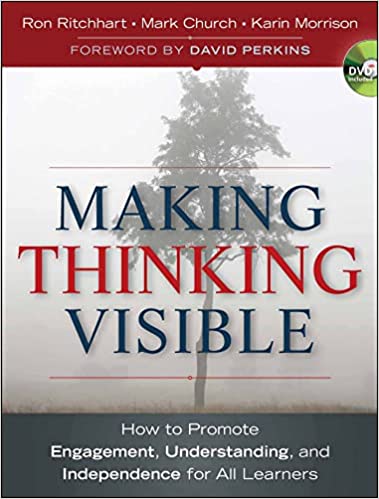
The authors of Making Thinking Visible suggest seven routines for metacognition:
1. What Makes You Say That? Interpretation with justification routine.
2. Think Puzzle Explore A routine that sets the stage for deeper inquiry.
3. Think Pair Share A routine for active reasoning and explanation.
4, Circle of Viewpoints A routine for exploring diverse perspectives.
5. I used to Think… Now I think… A routine for reflecting on how and why our thinking has changed.
6. See Think Wonder A routine for exploring works of art and other interesting things.
7. Compass Points A routine for examining propositions.
Clearly, REFLECTION is essential. Reflection allows students time to process their process, to think about their learning and thinking throughout any given activity. Use the routines listed above or use a reflection journal or prompt to help students build a new habit of mind that considers their thinking strategies.
Also, check out Diane Dahl’s metacognition lesson with pipe cleaners.
KEEP READING





Hi Melissa, this is an interesting sharing from you. May I have the reference for Figure 2.2? It would be helpful for my research. Thank you.
I found it here — https://dkrogers.edublogs.org/2011/10/11/revisiting-gradual-release-of-responsibility/.
Melissa,
Please contact me at tanny@fuse.net
This is in reference to your previous post about Metacognition.
Tanny McGregor
Author of Comprehension Connections (Heinemann, 2007)