What to Expect in a Writing Workshop
This post may contain affiliate links.
I want to tell you about writing workshops because my Imagination Soup writing classes are all workshop classes. It is the best way, in my well-researched and experienced opinion, to teach writing.
A Writer’s Workshop is best way to teach writing to children because it allows for choice, differentiation, individualization, reflection, and the belief in oneself as a writer. I say this based on over a decade of teaching experience and staff developer. Once I learned the 6 + 1 Traits of Writing and instructing with writing workshops, I became a teacher who taught writing well and a better writer myself.
What is a Writing Workshop?
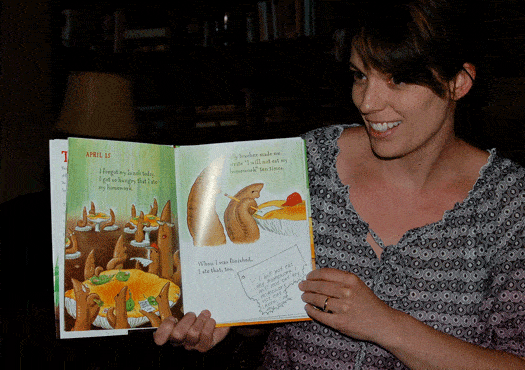
I. Teach Writing Craft With Writing Examples (also called mentor texts, read-alouds, touchstone books, and modeling writing with write-alouds.)
This is the craft of writing lesson using a picture book, or an excerpt from a text, with which the teacher and students use to learn and study craft. It is also the time where the teacher shows how she processes and makes decisions in her writing in front of the students, out – loud, modeling the craft lesson.
II. Writing Time for Writing, Conferring with Teacher, Conferring with Peers
This is a long period of time (30 – 60 minutes) for the students to apply the lesson to their own writing, confer with the teacher, confer with each other, or other writing such as draft, revise, edit, or publish. The teacher spends several minutes with each writer, talking about their writing – noticing what is working and suggestion something to work on. I usually gave my students a sticky note with a + for strengths and an arrow for a goal to work on. Teachers will keep this information in their own logs as well. I tried to meet with each students 1 – 2 times a week so every week I knew exactly what was happening with each student in writing. It is a very important part of the workshop as these conferences inform the teacher of what to teach — weaknesses, strengths, and so forth. The teacher asks guiding questions to help the student improve their reflections of their writing.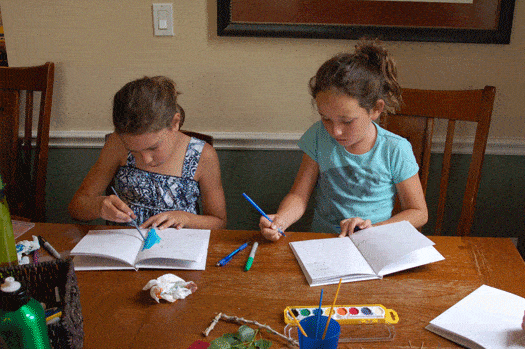
- Writing Time
III. Reflection and Author’s Chair
This is probably the most important and beneficial part in a writing workshop. This is where the students learn how to revise and reflect – on their own work and each others. An author shares while the other students listen. Depending on the time in the year and the age, what happens after will vary. Initially, you will ask the listeners to help inform the writer of strengths, probably based on the lesson. Further along in the year, listeners will ask questions and offer suggestions.
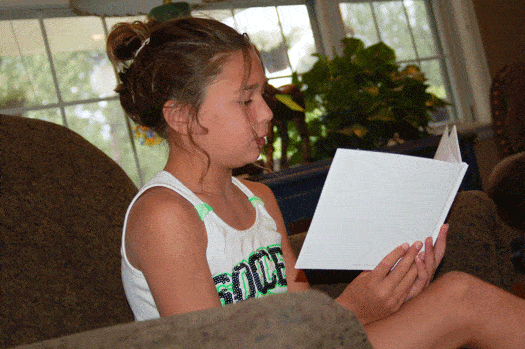
Writing Workshop for Homeschoolers
Create a space. You’ll love this writer’s writing space from blogger and author, Jennifer Hallissy.
Gather a group of writers. I found this eBook about writing workshop for homeschoolers that may or may not be helpful to you. Here’s a review of Writer’s Workshop for Homeschoolers.
Implement Writer’s Workshop.
*I would love to hear from any of you who are homeschoolers and doing writing workshop. What are the differences, challenges, benefits?
Resources for more information
Launching a Writer’s Workshop (Scholastic) by Elizabeth Mazzurco
Writer’s Workshop byTeaching that Makes Sense
The Writer’s Workshop: Working Through The Hard Parts by Katie Wood Ray ~ Sample Chapter
A Guide to the Writing Workshop, Grades 3 – 5 by Lucy Calkins
Can We Skip Lunch and Keep Writing? by Julie D. Ramsay
30 Ideas for Teaching Writing from the National Writing Project
Implementing the Writer’s Workshop in Kindergarten
The Writing Workshop: A Valuable Tool for Differentiation and Formative Assessment (edutopia) by Todd Finley
ALSO READ:



My girls have always had so much fun at your classes!
thanks, Jenny! That’s my goal. 🙂
I’m a huge fan of the writer’s workshop for homeschoolers! I’ve been facilitating them for more than ten years now, and they’ve probably been the biggest contributor to my three kids’ enthusiasm towards writing.
I facilitate workshops a little differently from the typical classroom model: we spend most of our workshop time discussing writing that the kids have done at home, and brought along. We spend a shorter amount of time doing a fun exercise in which we write together. This model has always worked well for my groups, as it supports the writing that kids are doing at home, and allows them to share pieces that they’ve spent more time on.
I wrote a post about our workshop discussions on my blog: http://patriciazaballos.com/2011/05/06/still-talking-literature/ I never fail to be amazed at how deeply kids can talk about literature.
I’m also at work on an e-book for homeschooled workshops. I keep trying to finish it, but it keeps growing!
I love this post – thanks for sharing it, Patricia. Your children / students are so fortunate to have such a passionate writer / teacher!